|
Arrival of Pres[iden]t of U[nited] S[tates]
|
123
Thursday ev[enin]g 3 July - 1817.
Yesterday James Monroe, pres[iden]t of U[nited] States, made
his entrance into Boston - He is now on a tour to the
middle & eastern states - and in returning intends,
it is said, to visit the lake shore & the Western part
of Pennsylvania. - Great preparations had been made
for his reception in Boston. He was received at the
line on the neck by the police, & committee of arrange-
ments - a procession was then formed, under the es-
cort of a squadron of cavalry, and composed of the
civil & military officers, a numerous cavalcade - &
a long line of carriages - This train proceeded thro’ the
common, where a lane was formed by the children of
both sexes arranged on either side, to the number of
Four Thousand - thence down winter street - Marlboro
Street - State Street - Broad-street - up State Street to
the head of Congress Street - where the Pres[ident] dis-
mounted & was escorted by the Cadets to the Ex-
Coffee House, where apartments had been furnished
|
|
|
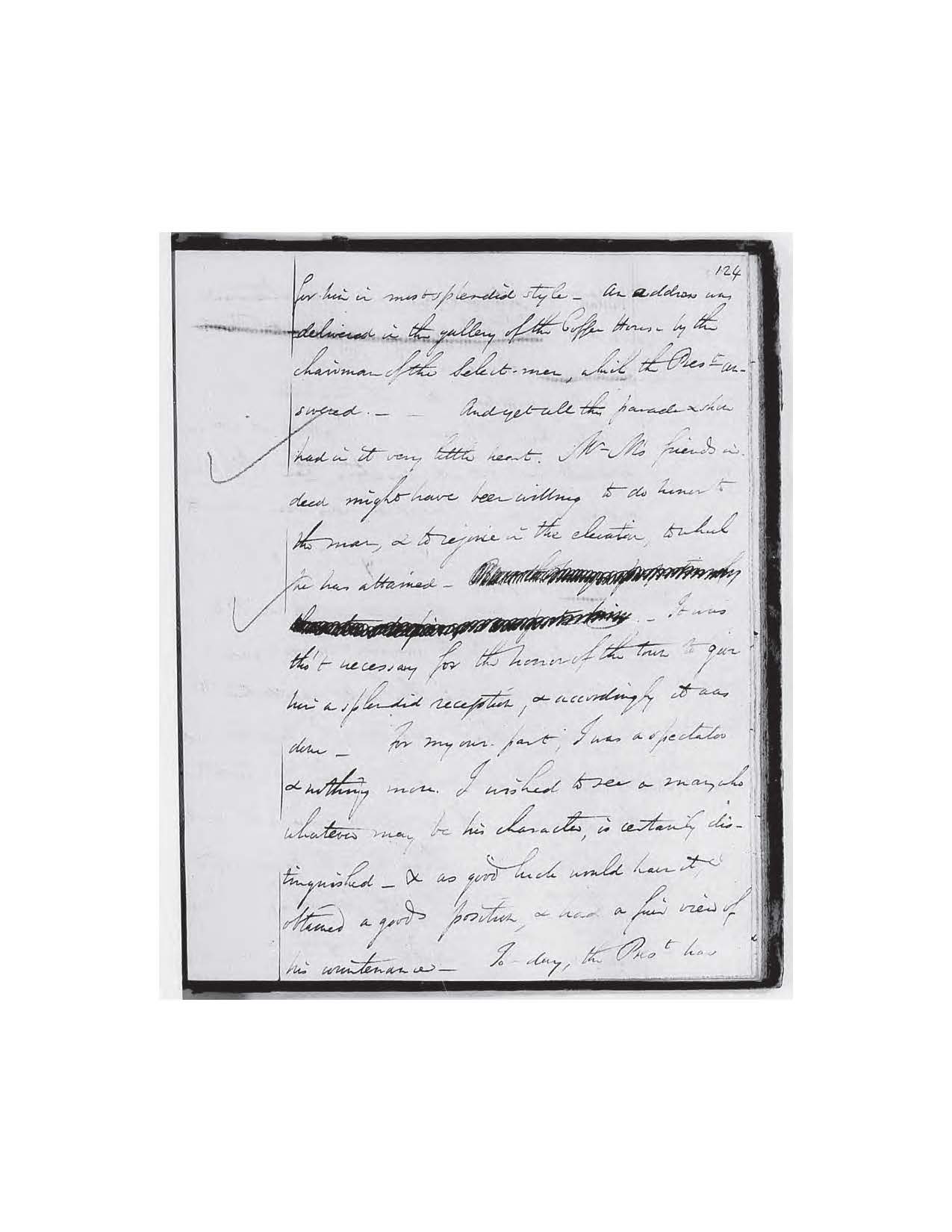
124
for him in most splendid style - An address was
delivered in the gallery of the Coffee House by the
chairman of the Select-men, which the Pres[ident] an-
swered . - - And yet all this parade & show
had in it very little heart. Mr M[onroe]’s friends in-
deed might have been willing to do honor to
the man, & to rejoice in the election, to which
he has attained - xxxxxxxxxxxxxxxxxxxxxxxxxxxx
xxxxxxxxxxxxxxxxxxxxxxxxxxxxxxxxxx . - It was
tho[ugh]t necessary for the honor of the town to give
him a splendid reception, & accordingly it was
done - For my own part, I was a spectator
& nothing more. I wished to see a man who
whatever may be his character, is certainly dis-
tinguished - & as good luck would have it, I
obtained a good position, & had a fine view of
his countenance - To-day, the Pres[ident] has
|
|
Vide Ante
Journal E,
pages 35-80 |
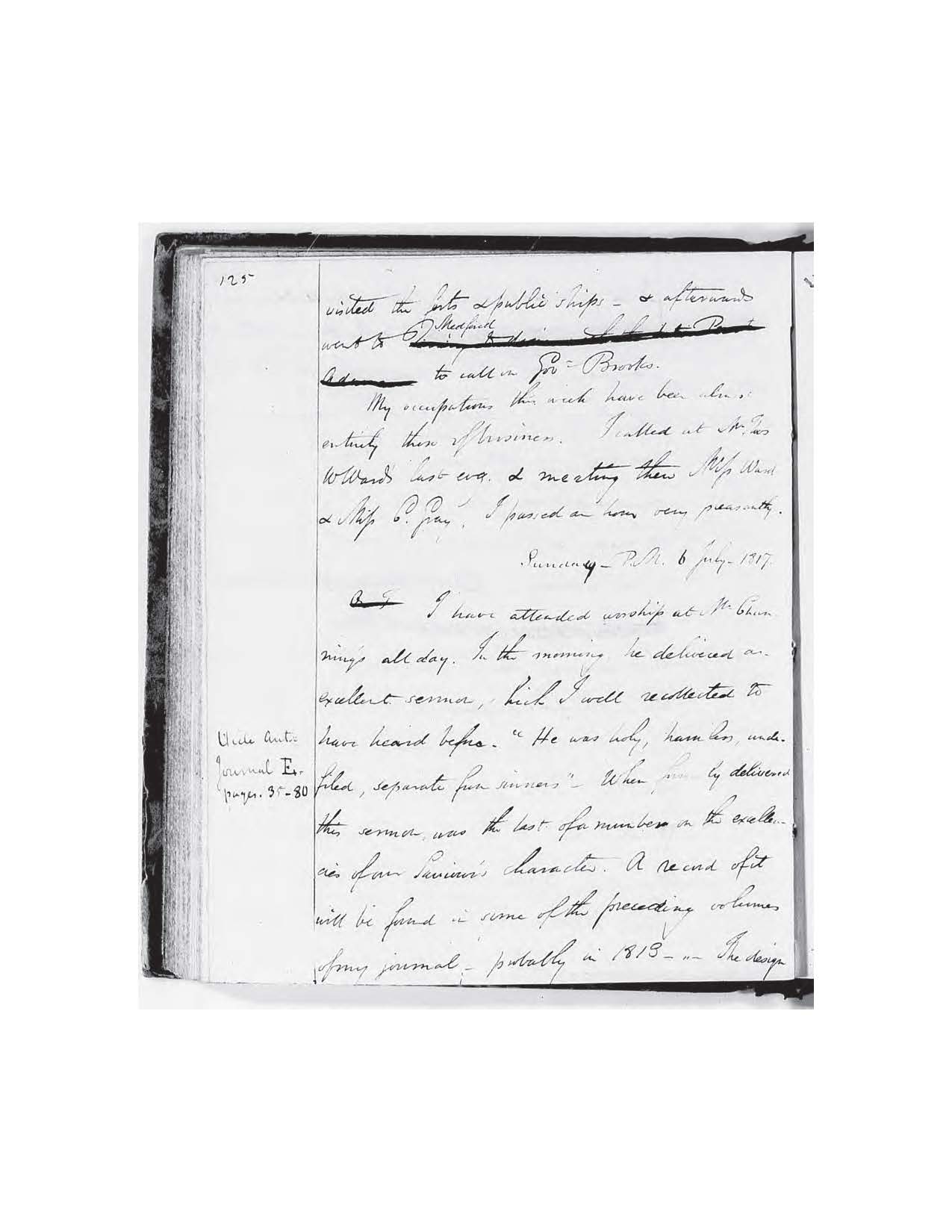
125
visited the forts & public ships - & afterwards
went to xxxxxxxxxxxxxxxxxxxxxxxxxxxxxxxxxxx
xxxxxxxxxxx ^ Medford to call on Gov[ernor] Brooks.
My occupations this week have been almost
entirely those of business. I called at Mr Tho[mas]
W. Ward’s last ev[enin]g & meeting there Miss Ward
& Miss C. Gray, I passed an hour very pleasantly.
Sunday - P.M. 6 July 1817.
One I I have attended worship at Mr Chan-
ning’s all day. In the morning, he delivered an
excellent sermon, which I well recollected to
have heard before - “He was holy, harmless, unde-
filed, separate from sinners” - When formerly delivered
this sermon was the last of a number on the excellen-
cies of our Saviour’s character. A record of it
will be found in some of the preceding volumes
of my journal - probably in 1813 - // - The design
|
|
|
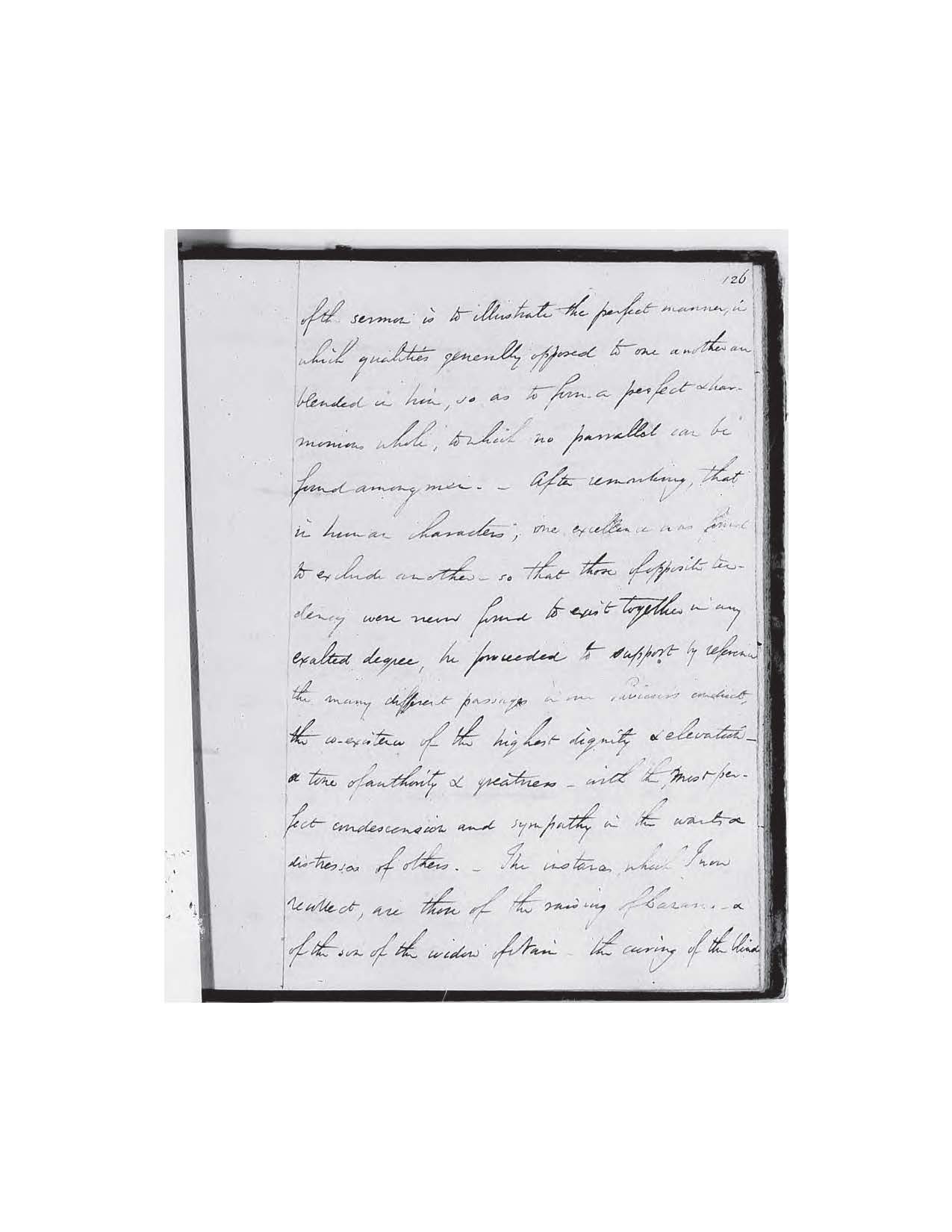
126
of the sermon is to illustrate the perfect manner, in
which qualities generally opposed to one another are
blended in him, so as to form a perfect & har-
monious whole, to which no parrallel can be
found among men. - After remarking, that
in human characters, one excellence was found
to exclude another - so that those of opposite ten-
dency were never found to exist together in any
exalted degree, he proceeded to support by reference
the many different passages in our Saviour’s conduct,
the co-existence of the highest dignity & elevation -
a tone of authority & greatness - with the most per-
fect condescension and sympathy in the wants &
distresses of others. - The instances, which I now
recollect, are those of the raising of Lazarus - &
of the son of the widow of Nain - the curing of the blind
|
|
|
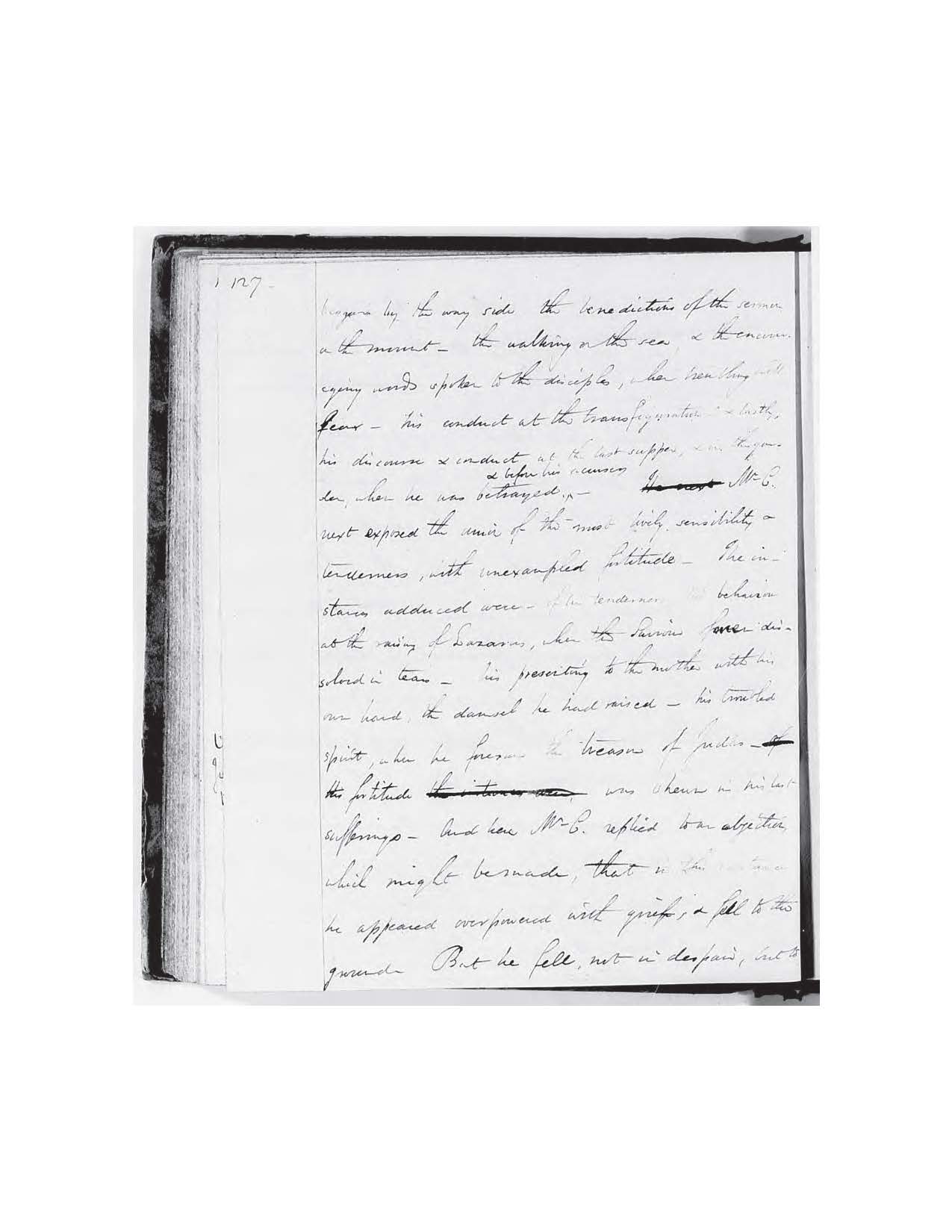
127
beggar by the way side - the benedictions of the sermon
on the mount - the walking on the sea, & the encour-
aging words spoken to the disciples, when trembling with
fear - his conduct at the transfiguration - & lastly,
his discourse & conduct at the last supper, & in the gar-
den, where he was betrayed, ^ & before his accusers - He next Mr C[hanning]
next exposed the union of the most lively sensibility &
tenderness, with unexampled fortitude - The in-
stances adduced were - of his tenderness, his behaviour
at the raising of Lazarus, when the Saviour often dis-
solved in tears - his presenting to the mother with his
own hand, the damsel he had raised - his troubled
spirit, when he foresaw the treason of Judas - of
the fortitude the instances were, was shewn in his last
sufferings - And here Mr C[hanning] replied to an objection,
which might be made, that in this instance
he appeared overpowerd with grief, & fell to the
ground - But he fell, not in despair, but to
|
|
Dine at Aunt Scott’s - probably for the last time
|
128
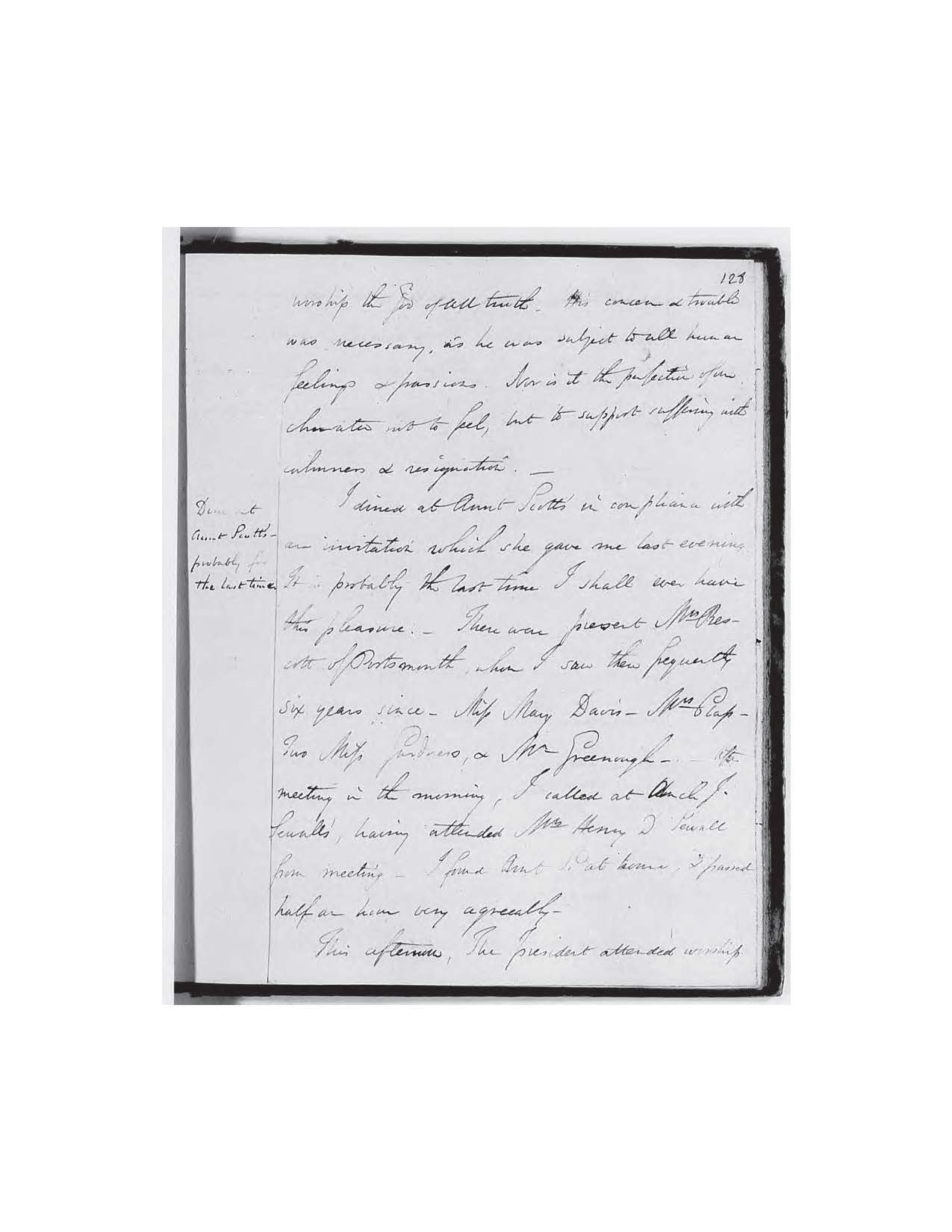
worship the God of all truth - His concern & trouble
was necessary, as he was subject to all human
feelings & passions. Nor is it the perfection of our
character not to feel, but to support suffering with
calmness & resignation. -
I dined at Aunt Scott’s in compliance with
an invitation which she gave me last evening.
It is probably the last time I shall ever have
this pleasure. - There were present Mrs Pres-
cott of Portsmouth, whom I saw there frequently
six years since - Miss Mary Davis - Mrs Clap -
Two Miss Gardners, & Mr Greenough - // - After
meeting in the morning, I called at Uncle J.
Sewall’s, having attended Mrs Henry D. Sewall
from meeting - I found Aunt S[ewall] at home, & passed
half an hour very agreeably -
This afternoon, The President attended worship
|
|
Sermon before Pres[iden]t Monroe
|
129
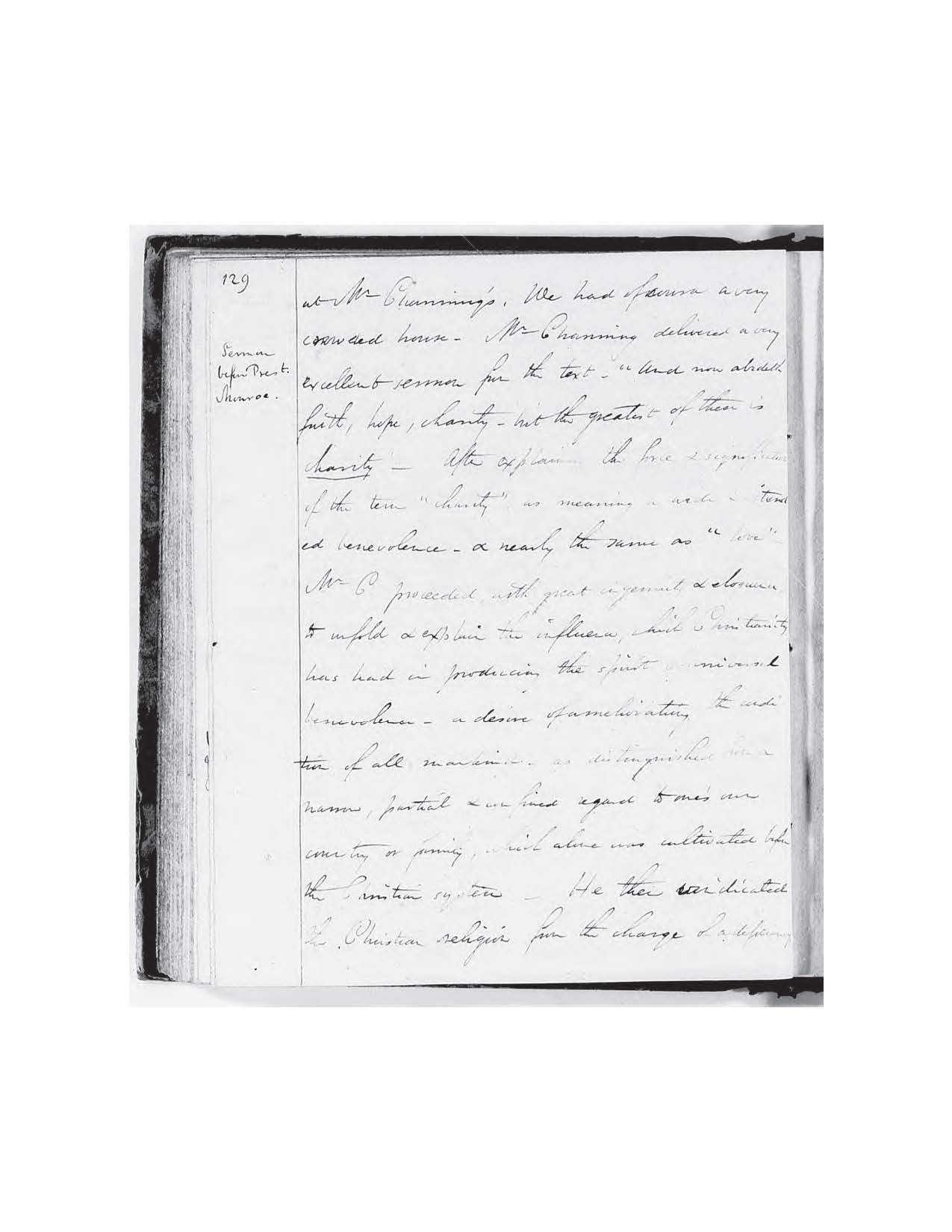
at Mr Channing’s. We had of course a very
crowded house - Mr Channing delivered a very
excellent sermon from the text - “And now abideth
faith, hope, charity - but the greatest of these is
charity” - After explaining the force & signification
of the term “charity”, as meaning a wide & extend-
ed benevolence - & nearly the same as “love” -
Mr C[hanning] proceeded, with great ingenuity & eloquence,
to unfold & explain the influence, which Christianity
has had in producing the spirit of universal
benevolence - a desire of ameliorating the condi-
tion of all mankind - as distinguished from a
narrow, partial & confined regard to one’s own
country or family, which alone was cultivated before
the Christian system - He then vindicated
the Christian religion from the charge of a deficiency
|
| |
130
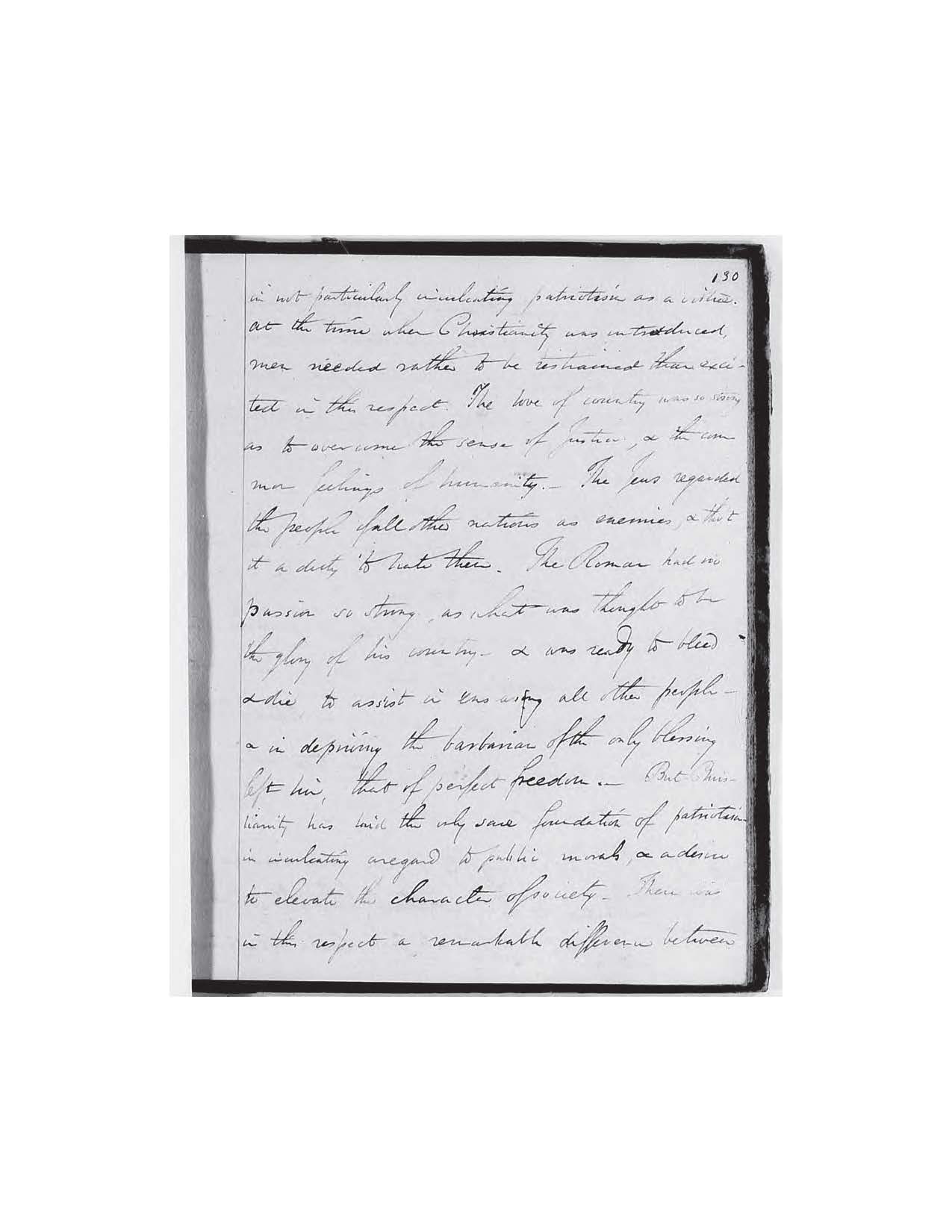
in not particularly inculcating patriotism as a virtue.
At the time when Christianity was introduced,
men needed rather to be restrained than exci-
ted in this respect. The love of country was so strong
as to overcome the sense of Justice, & the com-
mon feelings of humanity. - The Jews regarded
the people of all other nations as enemies, & tho[ugh]t
it a duty to hate them. The Roman had no
passion so strong, as what was thought to be
the glory of his country - & was ready to bleed
& die to assist in enslaving all other people -
& in depriving the barbarian of the only blessing
left him, that of perfect freedom. - But Chris-
tianity has laid the only sane foundation of patriotism -
in inculcating a regard to public morals, & a desire
to elevate the character of society - There was
in this respect a remarkable difference between
|
|
4th July 1817 -
Pres[iden]t Monroe
|
131
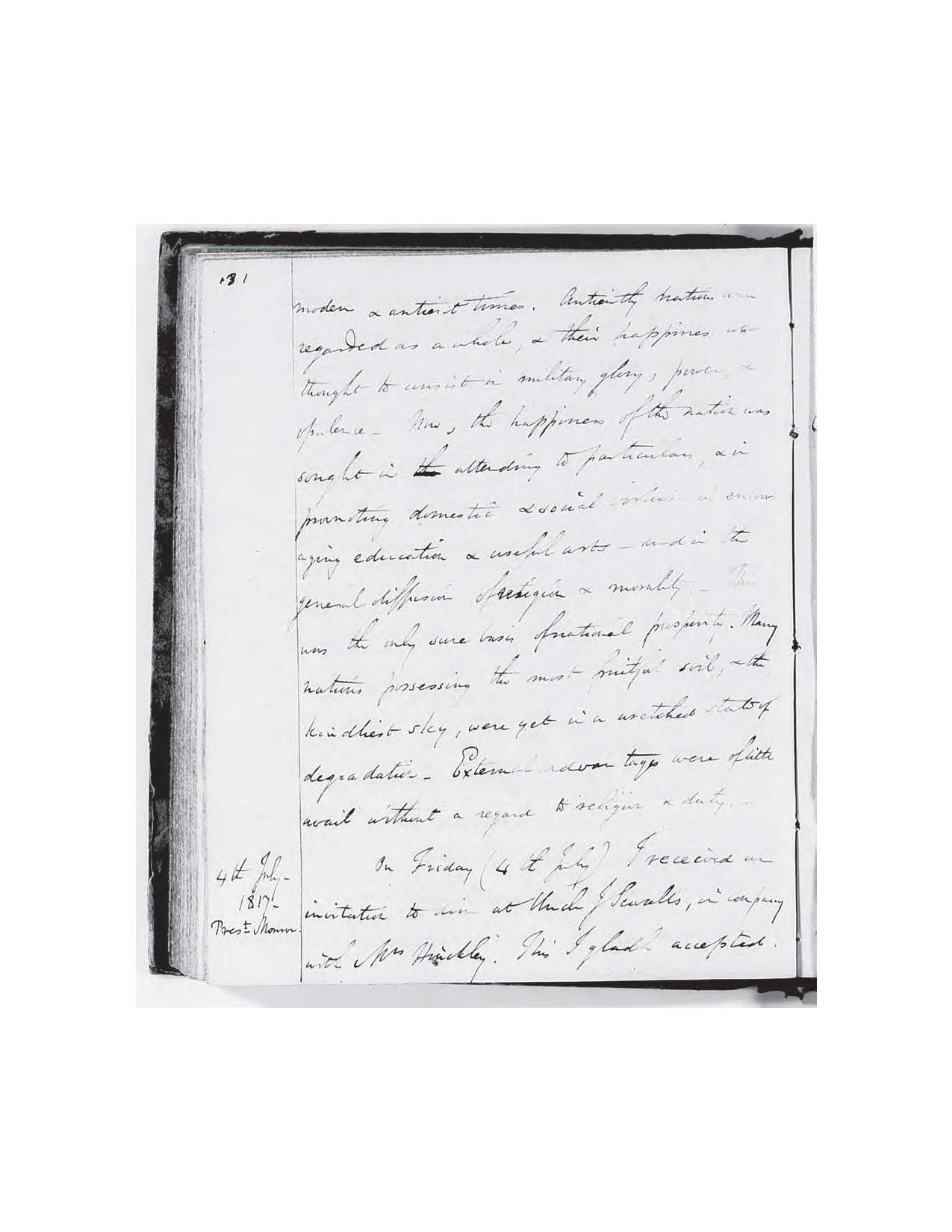
modern & antient times. Antiently nations were
regarded as a whole, & their happiness, was
thought to consist in military glory, power, &
opulence - Now, the happiness of the nation was
sought in the attending to particulars, & in
promoting domestic & social virtues - in encour-
aging education & useful arts - and in the
general diffusion of religion & morality. - This
was the only sure basis of national prosperity. Many
nations possessing the most fruitful soil, & the
kindliest sky, were yet in a wretched state of
degradation - External advantages were of little
avail without a regard to religion & duty . -
On Friday (4th July) I received an
invitation to dine at Uncle J Sewall’s, in company
with Mrs Hinckley. This I gladly accepted.
|
|
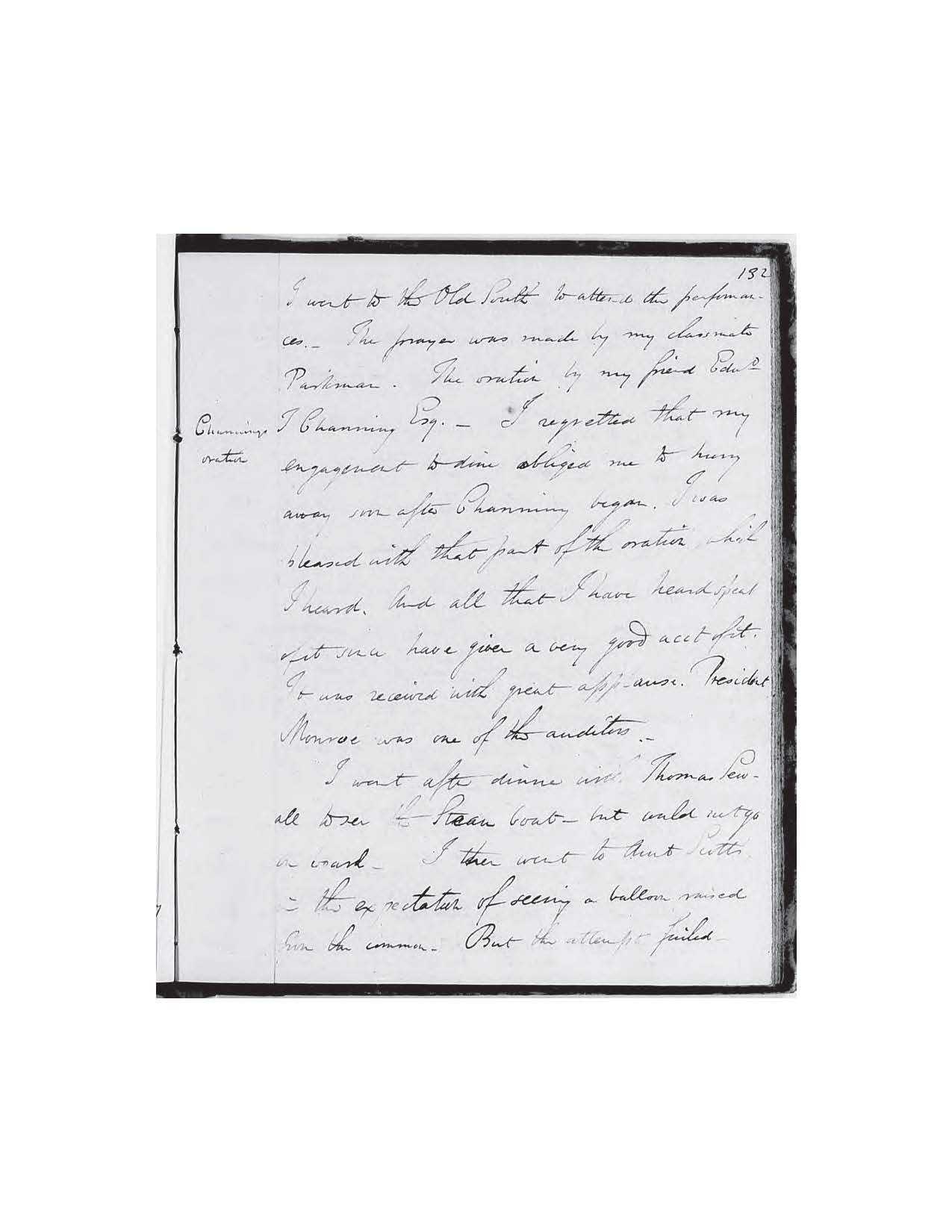
Channing’s oration
|
132
I went to the Old South to attend the performan-
ces. - The prayer was made by my classmate
Parkman. The oration by my friend Edw[ard]
T. Channing Esq[uire] - I regretted that my
engagement to dine obliged me to hurry
away soon after Channing began. I was
pleased with that part of the oration, which
I heard. And all that I have heard speak
of it since have given a very good acc[oun]t of it.
It was received with great applause. President
Monroe was one of the auditors. -
I went after dinner with Thomas Sew-
all to see the Steam boat - but could not go
on board - I then went to Aunt Scott’s
in the expectation of seeing a balloon raised
from the common - But the attempt failed -
|
|
|
133
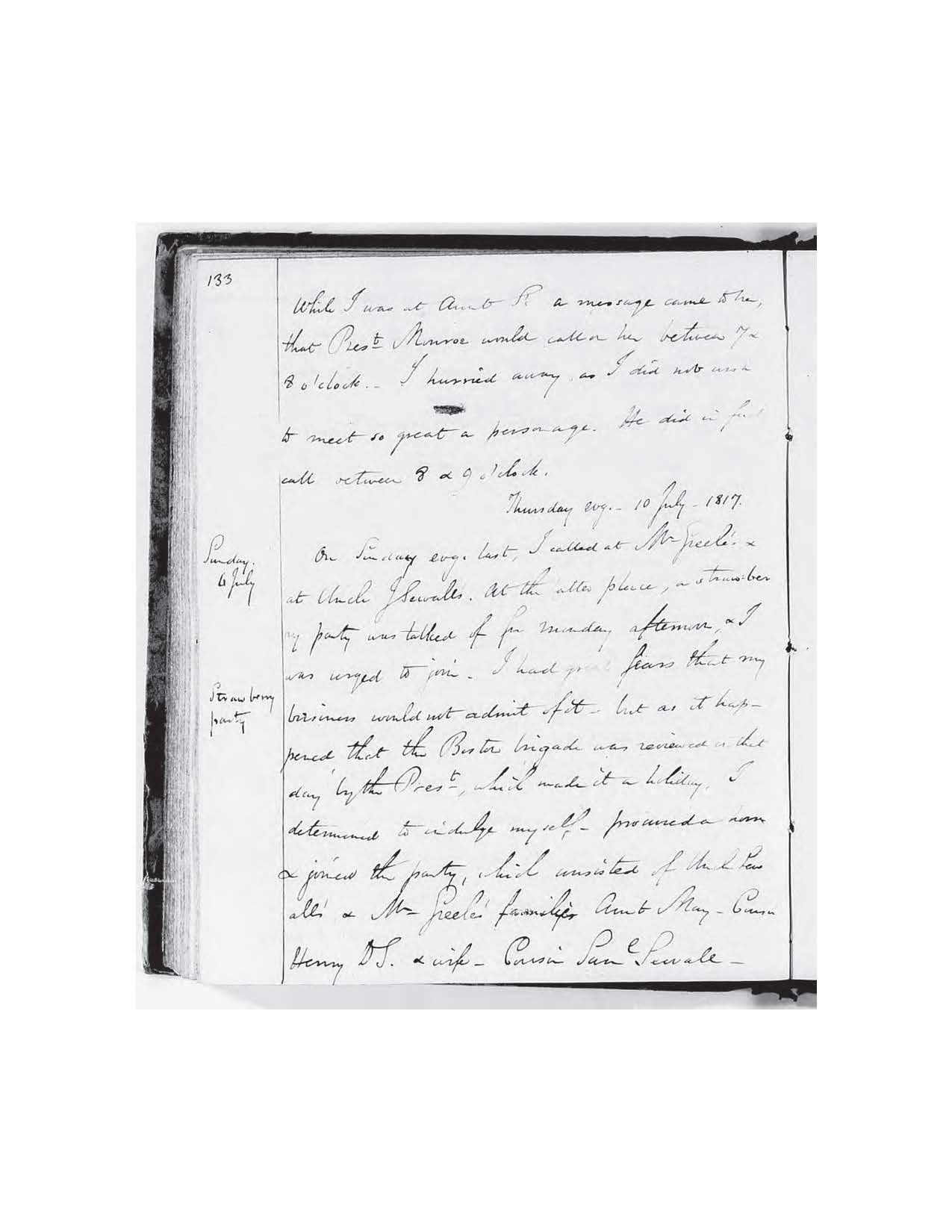
While I was at Aunt S[cott]’s a message came to her,
that Pres[iden]t Monroe would call on her between 7 &
8 o’clock. - I hurried away, as I did not wish
to meet so great a personage. He did in fact
call between 8 & 9 o’clock.
|