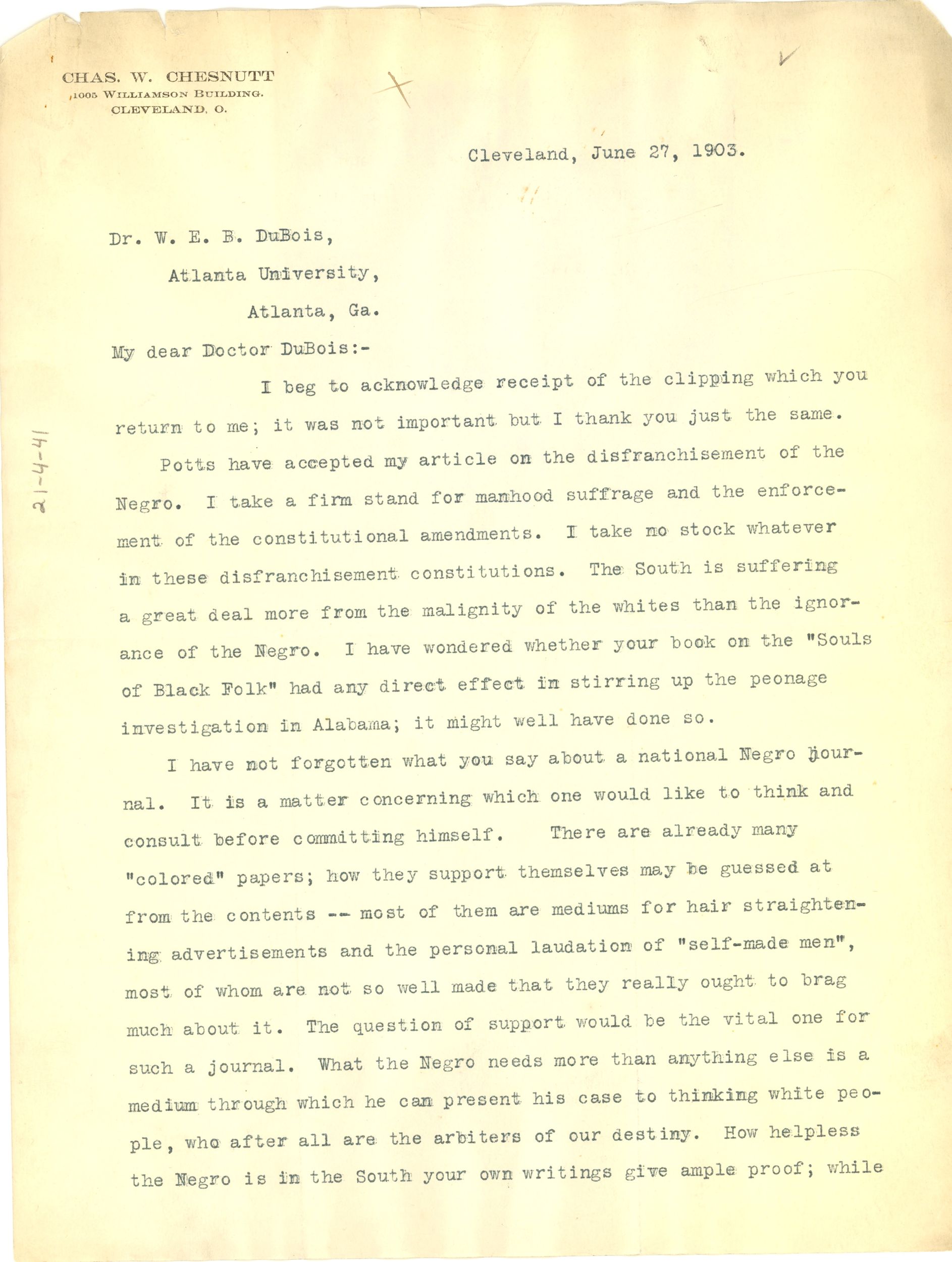
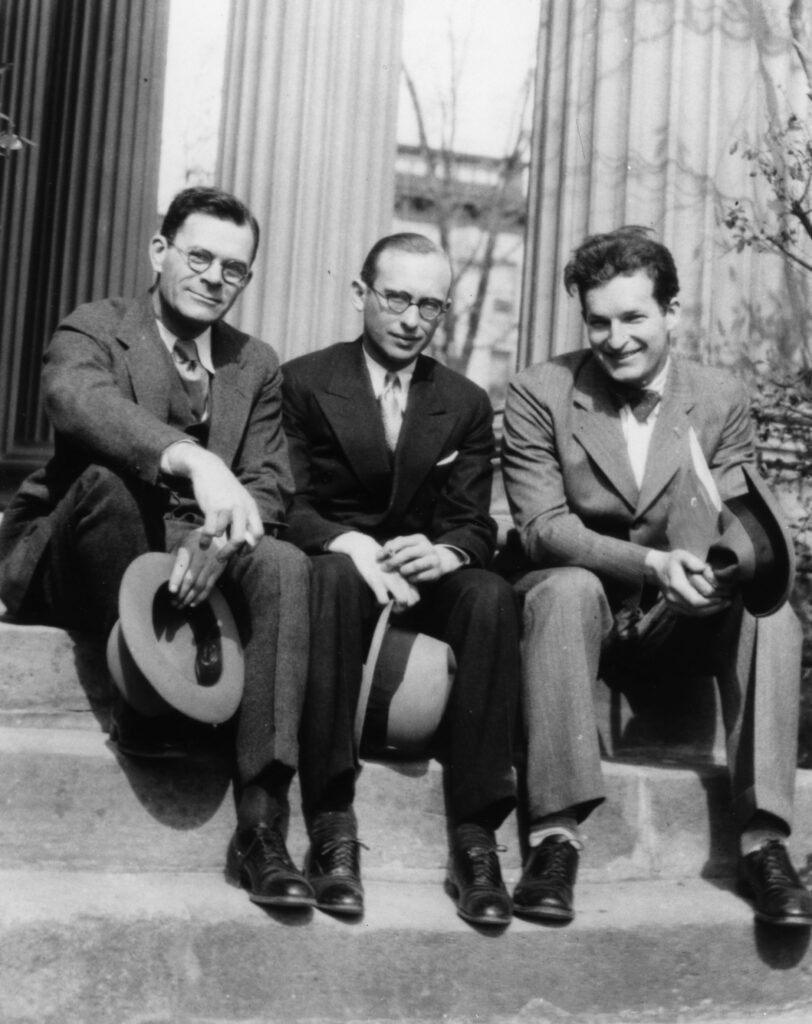
Correspondent: William Edward Burghardt Du Bois (1868–1963) was a sociologist, historian, and world-renowned civil rights activist. After completing coursework at the University of Berlin and Harvard University, Du Bois became the first African American to earn a doctorate from Harvard in 1895. He was a professor of history, sociology, and economics at Atlanta University (1897–1910 and again in the 1930s). He was a prominent leader of the Niagara Movement and helped found the NAACP in 1909. As the editor of the NAACP's journal, The Crisis, from 1910 to 1931, Du Bois published four of Chesnutt's short stories as well as two of his essays. See "The Doll" (April 1912), "Mr. Taylor's Funeral" (April/May 1915), "The Marked Tree" (Dec 1924/Jan 1925), and "Concerning Father" (May 1930); and "Women's Rights" (August 1915) and "The Negro in Art" (November 1926).
Annotations:
1. In an unlocated letter, Du Bois returned clippings of Horace Traubel's and William Dean Howells's reviews of Chesnutt's work that he had sent along with a biographical sketch; see Chesnutt's letter from May or early June 1903.
2. James Pott & Company was founded by James Pott (1829–1905) in the 1880s; his son James (1859–1931) joined the company in 1884. In January of 1903, the publishing house solicited essays from leading Black American writers for their book The Negro Problem, published in September 1903. Chesnutt's contribution, "Disfranchisement of the Negro," was one of seven essays. The other contributors were W. E. B. Du Bois, Booker T. Washington, Paul Laurence Dunbar, T. Thomas Fortune, Wilford H. Smith, and H. T. Keeling.
3. Chesnutt addressed the question of the franchise and suppression of the Black vote in the South often, including in his 1903 essay "The Disfranchisement of the Negro."
4. W. E. B. Du Bois' influential analysis of Black life in the United States, The Souls of Black Folk: Essays and Sketches, was published in April 1903 (Chicago: A. C. McClurg). Several of the essays, which combined sociological analysis with a powerful literary style, had previously appeared in the Atlantic Monthly.
5. Peonage, a system of debt imprisonment that allowed for widespread continuation of enslaved labor for Black people, had become widespread across the South in the 1890s. An important grand jury trial, under the auspices of federal district Judge Thomas G. Jones (1844–1914) about a peonage machine in Alabama's Coosa and Tallapoosa counties, occurred in the summer of 1903 and was widely covered in the press. Chesnutt addressed peonage most directly in his 1905 novel The Colonel's Dream.
6. In 1903, W. E. B. Du Bois contemplated launching a new journal with a focus on race that could reach a wide audience, and he consulted a number of Black and White allies. After editing the short-lived Moon Illustrated Weekly, which only had a circulation of a few hundred copies (December 1905 to mid-1906) and another magazine that folded after three years, The Horizon: A Journal of the Color Line (1907–1910), Du Bois, under the NAACP's auspices, launched a monthly magazine, The Crisis (1910–present). It had a circulation of one hundred thousand by 1918, and Du Bois served as editor from 1910 to 1934.
7. After visiting Knoxville College and the Tuskegee Institute in July, W. E. B. Du Bois and his wife Nina (ca. 1870–1950) spent the late summer of 1903 in the Boston suburb of Dorchester, Massachusetts, at 97 Sawyer Avenue, the home of William Monroe Trotter (1872–1934) and Geraldine Pindell Trotter (1872–1918). Chesnutt does not seem to have traveled to Boston to meet Du Bois.
8. W. E. B. Du Bois's article "Possiblities of the Negro: The Advance Guard of the Race" was published in Booklovers Magazine 2, no. 1 (July 1903): 2–15. In his brief illustrated sketches of accomplished Black men, he juxtaposed poet Paul Laurence Dunbar (1872–1906) and painter Henry Ossawa Tanner (1859–1937) with Chesnutt (see page 13). The portrait photograph Chesnutt sent to the publishers was reprinted on page 9.