The Higher Patriotism

  1. 250th Gallery
  2. The Higher Patriotism

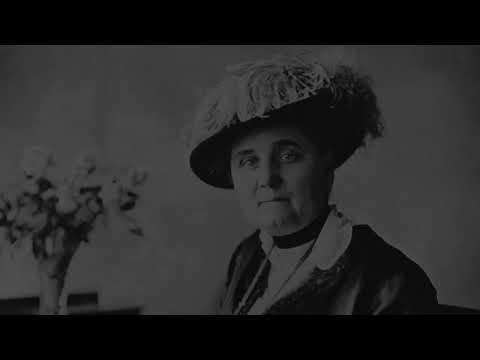
Jane Addams traveled to Boston with Mary McDowell to attend the Thirteenth Universal Peace Congress, October 3-8, 1904. This document is pulled from the final three paragraphs of speech Addams delivered on October 5, at the Park Street Church the Public Meeting of Women. Entitled “The Responsibilities and Duties of Women toward the Peace Movement,” it was the first of three addresses Addams delivered at the Congress.

The Thirteenth Universal Peace Congress, the second to be held in the United States, occurred in the context of the emergence of the United States as a new world power. Illustrative of Addams’s developing theories of peace up to this point, this speech connects democracy and self-government with peace, and it makes the argument that peace is a more heroic path than violence. Addams challenged Americans to think carefully about their growing power. She argued that it was time to define patriotism not as an ethnocentric nationalism but rather as a devotion to the ideal of democracy itself and the idea that all peoples, no matter their color or creed or country, are worthy of peace and self-government. This early example of Addams’s ideas about peace links it to her insistence on a moral grounding for democracy, her opposition to colonialism, and her view that patriotism should serve a higher ideal than nationalism. Addams rejected the common definition of patriotism as stressing support of one’s country to negate the interests of others, believing instead that cooperation would increase resources and improve conditions for everyone.

At the Public Meeting of Women, Lucia Ames Mead (1856-1936), a Boston pacifist, served as the moderator, calling the meeting to order at 8 p.m. Sarah Unwin Byles (1844-1931), wife of English pacifist newspaper publisher William Byles, preceded Addams at the podium. Following Addams were: Helen E. Dunhill (1857-?), an English-born missionary in India; Dr. Yamei Kin (1864-1934), a Chinese physician educated at Women’s Medical College of New York; poet and pacifist Julia Ward Howe (1819-1910) of Boston; Willhelmina Sheriff Bain (1848-1944), a feminist and pacifist from New Zealand; and Austrian pacifist Baroness Bertha von Suttner (1943-1914).

For Addams, attendance at the Congress was inspirational. She reported home that she and Mary McDowell were both feeling “very enthusiastic” about the meetings. She also wrote that the Congress was all “really very stirring and fine.” Addams gave two other speeches that week: “The Interests of Labor in International Peace” during the Workingman’s Public Meeting in Faneuil Hall, October 5, and an address at the Congress Banquet in Horticultural Hall, October 7.
Read More
Document
Information
    THE HIGHER PATRIOTISM
by
JANE ADDAMS
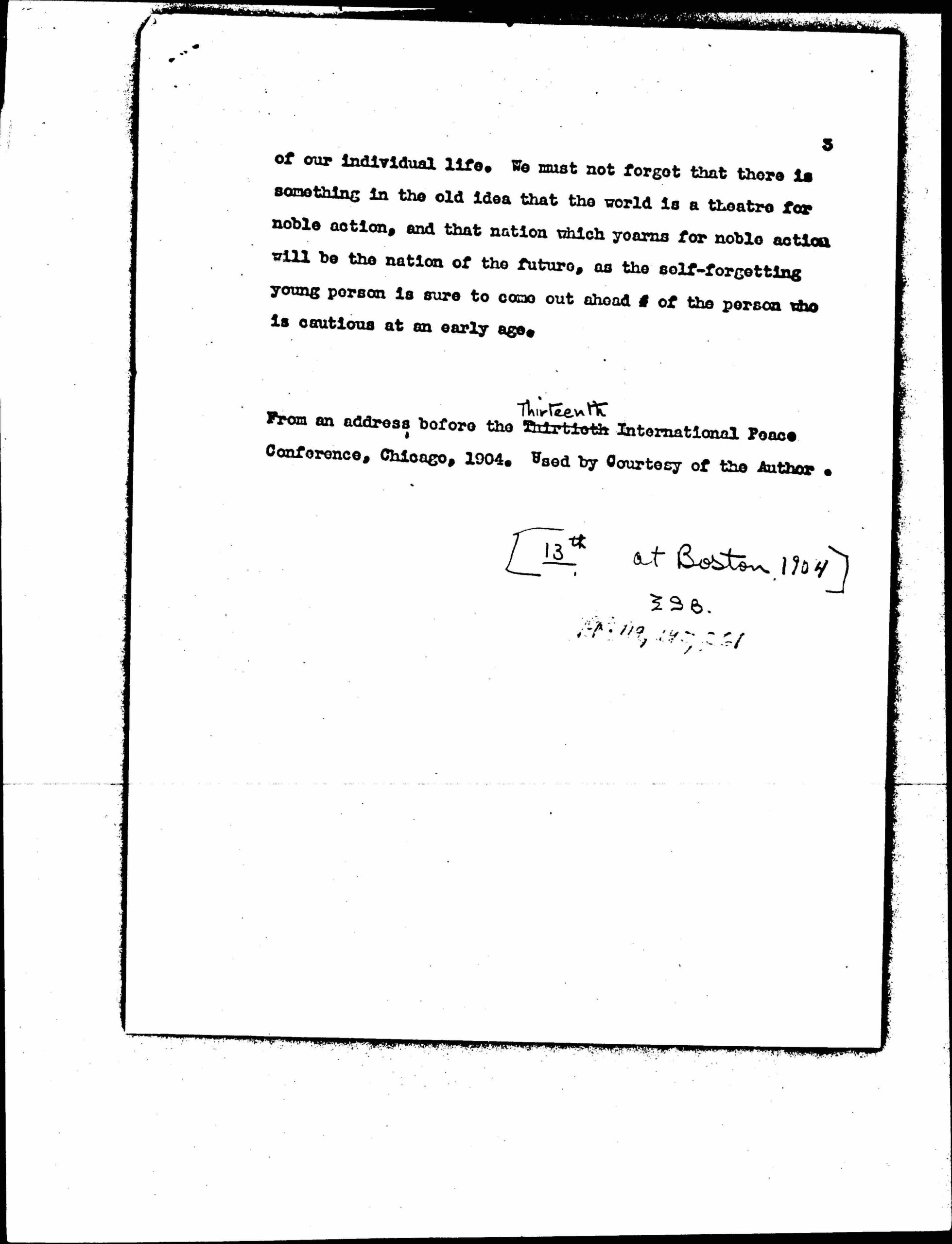
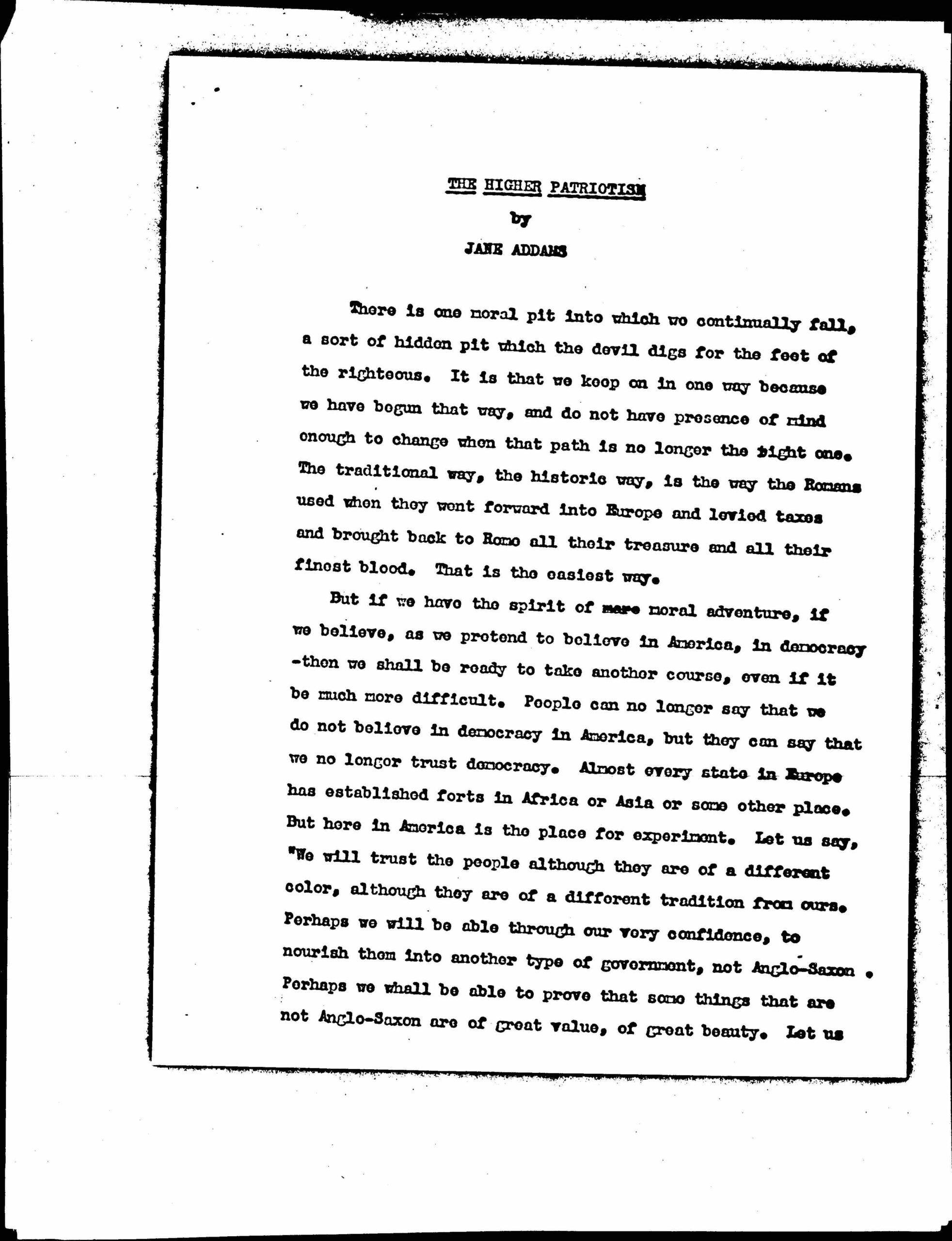
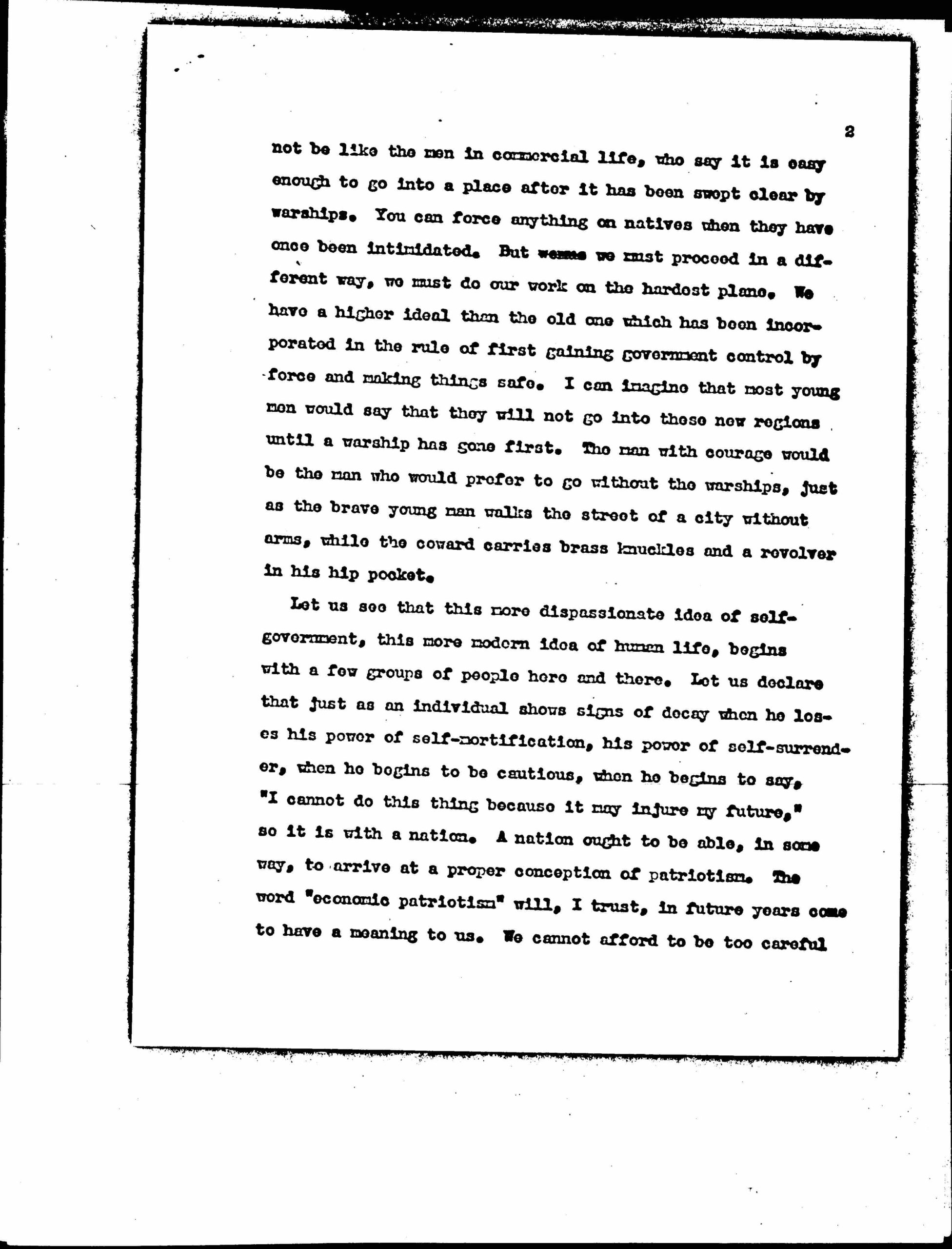
There is one moral pit into which we continually fall, a sort of hidden pit which the devil digs for the feet of the righteous. It is that we keep on in one way because we have begun that way, and do not have presence of mind enough to change when that path is no longer the right one. The traditional way, the historic way, is the way the Romans used when they went forward into Europe and levied taxes and brought back to Rome all their treasure and all their finest blood. That is the easiest way. But if we have the spirit of [more] moral adventure, if we believe, as we pretend to believe in America, in democracy -- then we shall be ready to take another course, even if it be much more difficult. People can no longer say that we do not believe in democracy in America, but they can say that we no longer trust democracy. Almost every state in Europe has established forts in Africa or Asia or some other place. But here in America is the place for experiment. Let us say, "We will trust the people although they are of a different color, although they are of a different tradition from ours. Perhaps we will be able through our very confidence, to nourish them into another type of government, not Anglo-Saxon. Perhaps we shall be able to prove that some things that are not Anglo-Saxon are of great value, of great beauty. Let us [page 2] not be like the men in commercial life, who say it is easy enough to go into a place after it has been swept clear by warships. You can force anything on natives when they have once been intimidated. But we must proceed in a different way, we must do our work on the hardest plane. We have a higher ideal than the old one which has been incorporated in the rule of first gaining government control by force and making things safe. I can imagine that most young men would say that they will not go into these new regions until a warship has gone first. The man with courage would be the man who would prefer to go without the warships, just as the brave young man walks the street of a city without arms, while the coward carries brass knuckles and a revolver in his hip pocket. Let us see that this more dispassionate idea of self-government, this more modern idea of human life, begins with a few groups of people here and there. Let us declare that just as an individual shows signs of decay when he loses his power of self-mortification, his power of self-surrender, when he begins to be cautious, when he begins to say, "I cannot do this thing because it may injure my future," so it is with a nation. A nation ought to be able, in some way, to arrive at a proper conception of patriotism. The word "economic patriotism" will, I trust, in future years come to have a meaning to us. We cannot afford to be too careful [page 3] of our individual life. We must not forget that there is something in the old idea that the world is a [theater] for noble action, and that nation which yearns for the noble action will be the nation of the future, as the self-forgetting young person is sure to come out ahead of the person who is cautious at an early age. From an address before the Thirtieth ↑Thirteenth↓ International Peace Conference, Chicago, 1904. Used by Courtesy of the Author.

↑{13th at Boston 1904}↓

Notes & Annotations

Sources: Tadd Ruetenik, “Jane Addams, Expansive Masculinity, and the Fragility of the War Virtues,” in Patricia M. Shields, Maurice Hamington, and Joseph Soeters, eds., The Oxford Handbook of Jane Addams (Oxford University Press, 1923), 433; Official Report of the Thirteenth Universal Peace Congress (Peace Congress Committee, 1904); Jane Addams diary, 2-4 October 1904, Jane Addams Papers Microfilm, reel 29:1007-1008; Democracy or Militarism, 1899; Commercialism Disguised as Patriotism and Duty, February 18, 1900; Jane Addams to Lillian D. Wald, October 3, 1904; Jane Addams to Mary Rozet Smith, October 5, 1904, all in Jane Addams Digital Edition.

Institution(s):

The Jane Addams Papers Project is supported by Ramapo College of New Jersey, the National Endowment for the Humanities, the National Historical Publications and Records Commission, the New Jersey Council for the Humanities, the Gladys Krieble Delmas Foundation, the Ramapo College Foundation, the Ruth McCormick Tankersley Charitable Trust, and generous individual donors.

Editor(s):

Cathy Moran Hajo, Editor and Director; Stacy Lynn, Associate Editor. Editorial work on the Higher Patriotism was also provided by Caitlin Biebrich. Work on the video presentation was done by Ramapo students Gianna Amato and Maryellen Kane, with assistance from Professor Rebecca Leung.

Source Note

Jane Addams Papers, Swarthmore Peace Collection, Swarthmore College.

Editorial Process & Document History

Additional Details

The Association for Documentary Editing

The ADE brings historical documents to life by helping editors preserve, interpret, and share important records from the past with the public.