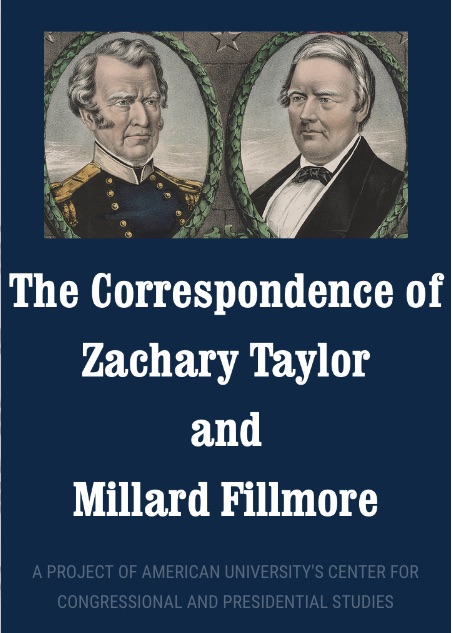
The Correspondence of Zachary Taylor and Millard Fillmore is assembling an edition of letters written by or to those men between 1844 and 1853. During that decade, which preceded and included their terms in the White House, the United States expanded its boundaries and enacted reforms while advancing toward civil war. It annexed the Republic of Texas, won control of California and the Southwest through a war with Mexico, passed compromise legislation on slavery, debated women’s and immigrants’ roles in society, and continued forcibly removing Indigenous peoples from their ancestral lands. Taylor and Fillmore helped lead those initiatives and conversations.
Taylor (1784–1850) owned plantations and enslaved people to work them in Kentucky, Louisiana, and Mississippi. A career soldier, he commanded US forces in conflicts against Native peoples, led troops into Texas in 1845, and became a lead general in the Mexican-American War of 1846–48. Military fame propelled him to election as president, on the Whig Party ticket, in 1848. Fillmore (1800–1874), meanwhile, an Erie County, NY, lawyer, served in the New York House and the US House before seeking (and losing) the Whig vice-presidential nomination and the governor’s seat in 1844. He became the University of Buffalo’s founding chancellor in 1846, state comptroller in 1848, and Taylor’s running mate that June. After Taylor died in 1850, he took over as president. In the White House, both men negotiated with Congress over whether the western lands Taylor had helped win from Mexico would permit slavery. The final Compromise of 1850 included California’s admission to statehood with slavery illegal, the organization of the Southwest into territories with slavery allowed, and a divisive new Fugitive Slave Act.
This edition, though designed around two powerful men, features the voices of diverse North Americans. While Taylor was the lead US official in the Texas republic and Mexico, men and women from all three nations told him of their sufferings amid the diplomatic and military crisis. While Fillmore served as New York’s chief financial officer, constituents wrote to him on business including state annuities to Indigenous residents and state funds for Black orphans’ education. During the presidential campaign and administrations, prominent and obscure Americans shared opinions on slavery, disunion, gender, immigration, technology, tariffs, literature, and numerous other topics. Most letters in the edition, as a result, are those written to rather than by the presidents. At a time when literacy among Whites was high and outgoing postage was usually free, people from all walks of life wrote to their leaders, and presidents’ letters became documentary slices of US political, social, economic, and cultural history.
The Taylor-Fillmore project has begun opening access to those primary sources for students, scholars, and all readers. In August 2026, the University of Tennessee Press published the series’ first volume. The Correspondence of Zachary Taylor and Millard Fillmore, volume 1, January 1844–June 1848 features 369 annotated letters (plus 4 enclosures) stretching from the prelude to Texas annexation through the close of the Mexican-American War. Two more volumes will cover the election of 1848 and both presidencies. Volume 1 is available in hardcover, as an ebook, and on JSTOR. In 2027 it will be added to the American Documentary History Collection, a cross-searchable collection of documentary editions by the University of Virginia Press’s Rotunda imprint, and will be released as an open-access pdf in the American University Research Archive.
In this gallery, we share one of the letters from volume 1. In it, artist Elizabeth Milligan reflects on the wonders of nature and on her experiences painting portraits. Having recently painted Dolley Payne Todd Madison on ivory (shown here), she describes that former first lady and former president John Quincy Adams as “links that connect ours with a past age.