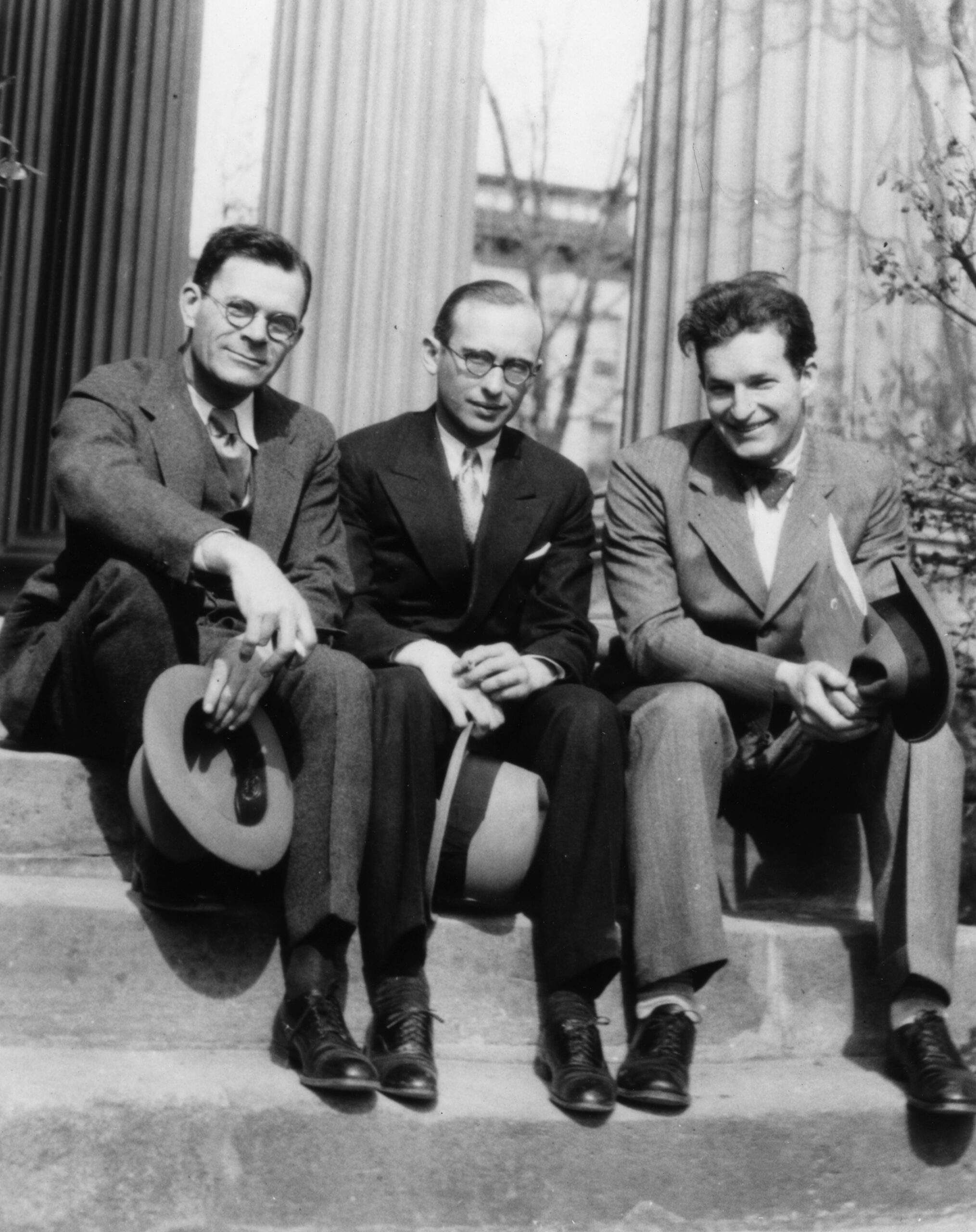
The Cherokee dramatist Lynn Riggs, the author of six plays produced on Broadway, was born in the Cherokee Nation, Indian Territory, in 1899, a decade into the land runs that led to the loss of millions of acres of Indigenous land. Soon after his eighth birthday in 1907, and following the implementation of the General Allotment and Curtis Acts in the Indigenous nations of Indian Territory, Oklahoma became a state, and those Indigenous nations saw the dissolution of their governments. Riggs set many of his plays in the Cherokee Nation, including Green Grow the Lilacs (1931), the source play for Oklahoma! (1943), the first collaboration between the legendary Broadway musical team Rodgers and Hammerstein. Riggs wrote his most explicitly Cherokee play, The Cherokee Night (1932), during the same period that he wrote Green Grow the Lilacs. Green Grow the Lilacs has been until recently the most well-known of his plays to both theater aficionados and drama scholars. But since the mid-1990s, The Cherokee Night has earned the most attention from scholars in Native American and Indigenous Studies as part of the recovery efforts that have so remarkably expanded our understanding of Native American literary history before the publication of Kiowa author N. Scott Momaday’s novel House Made of Dawn in 1968 initiated the Native American Renaissance.
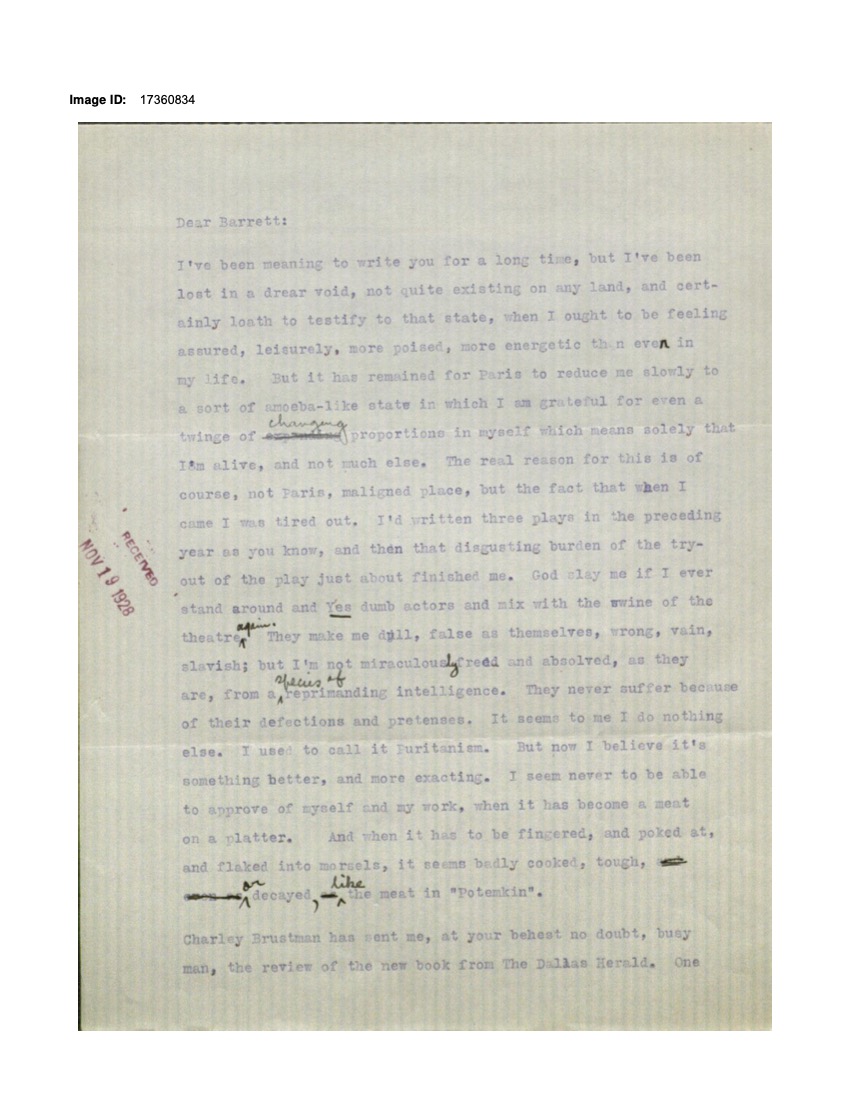
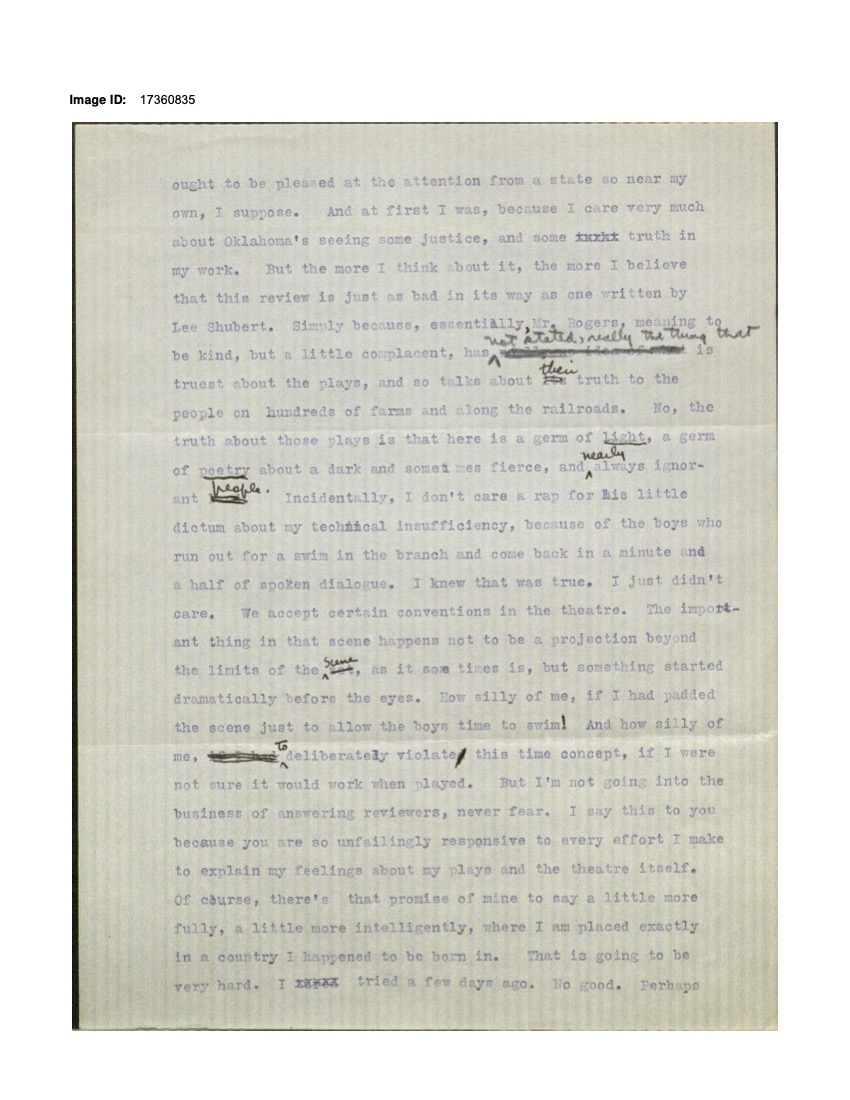
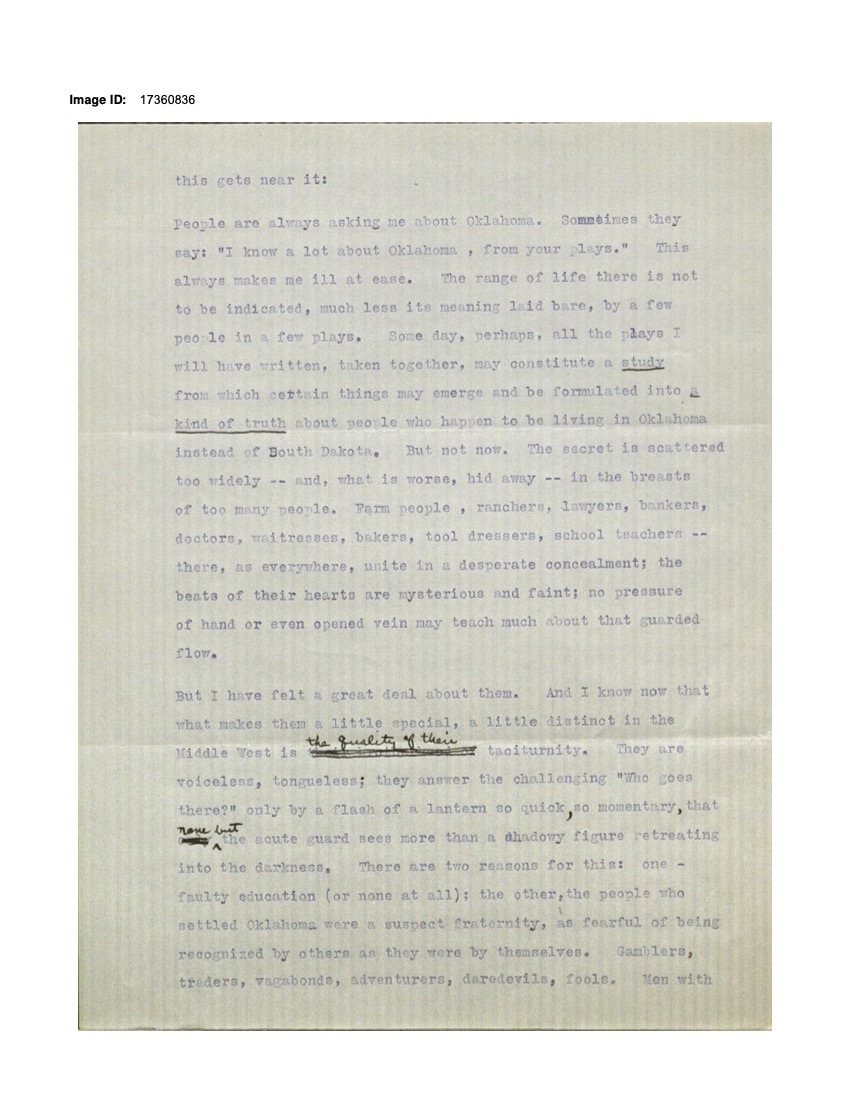
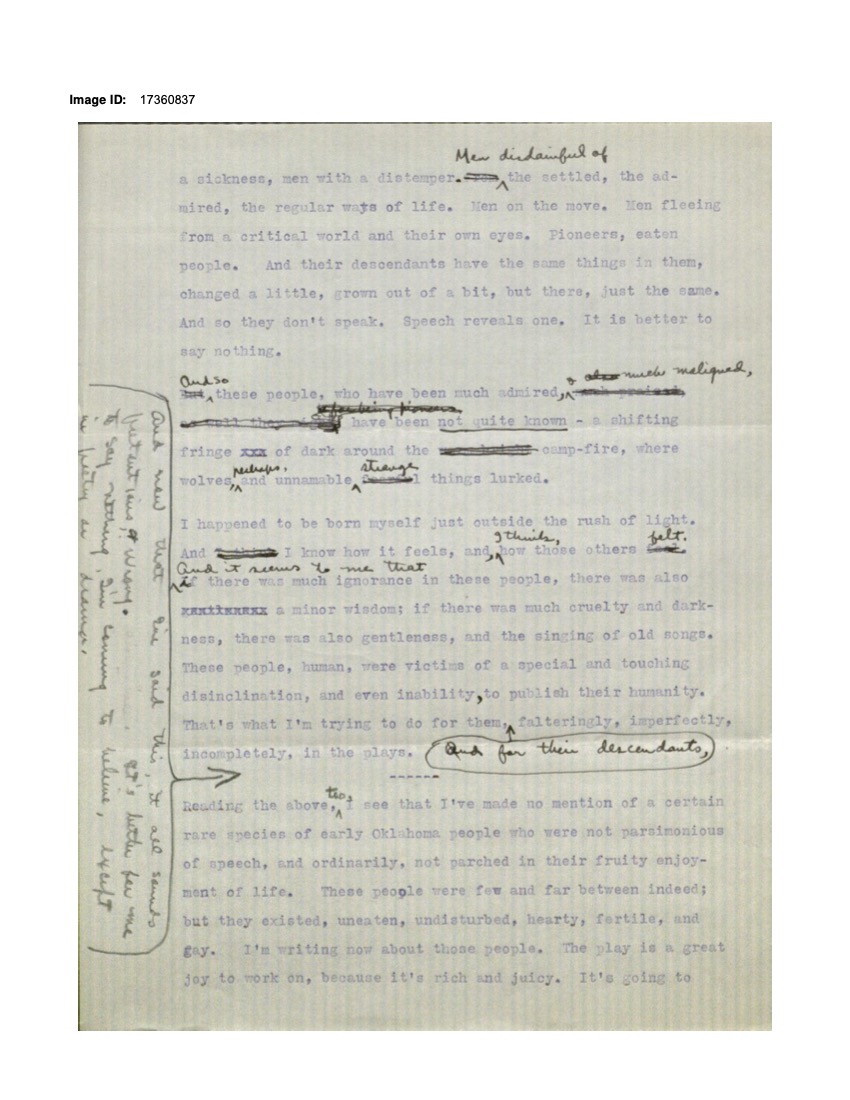
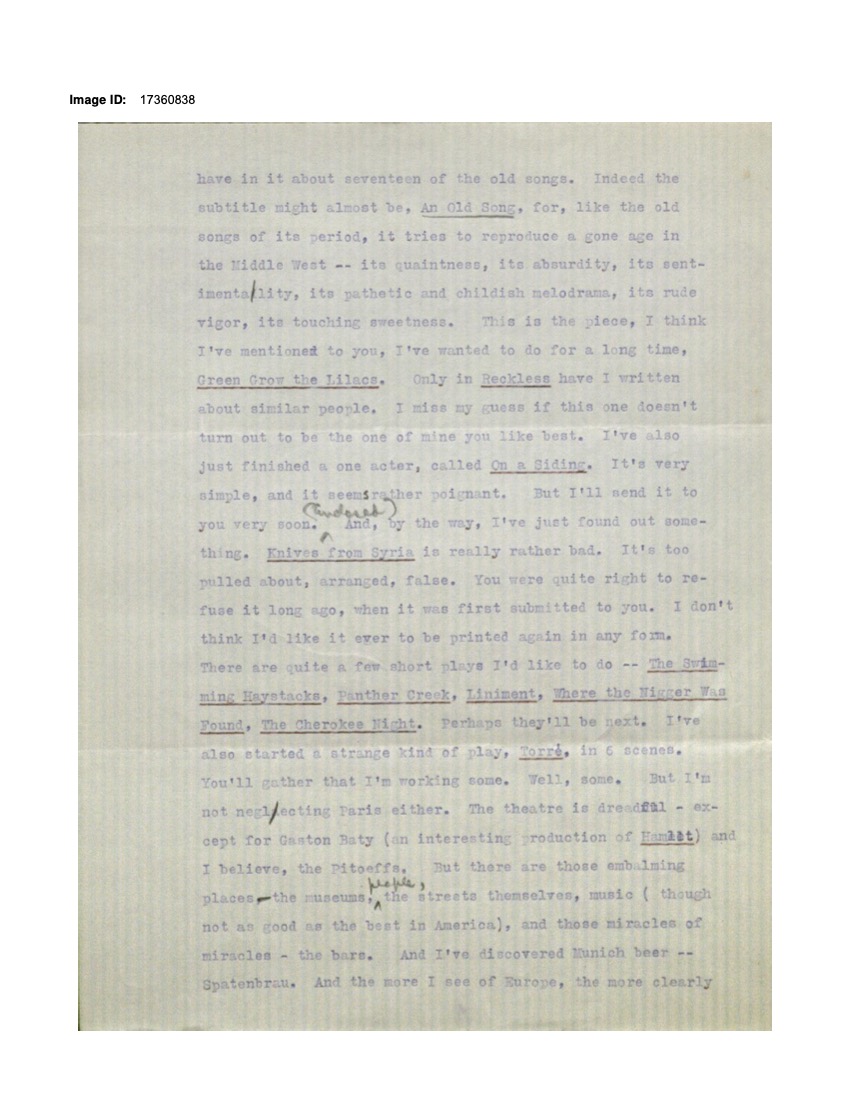
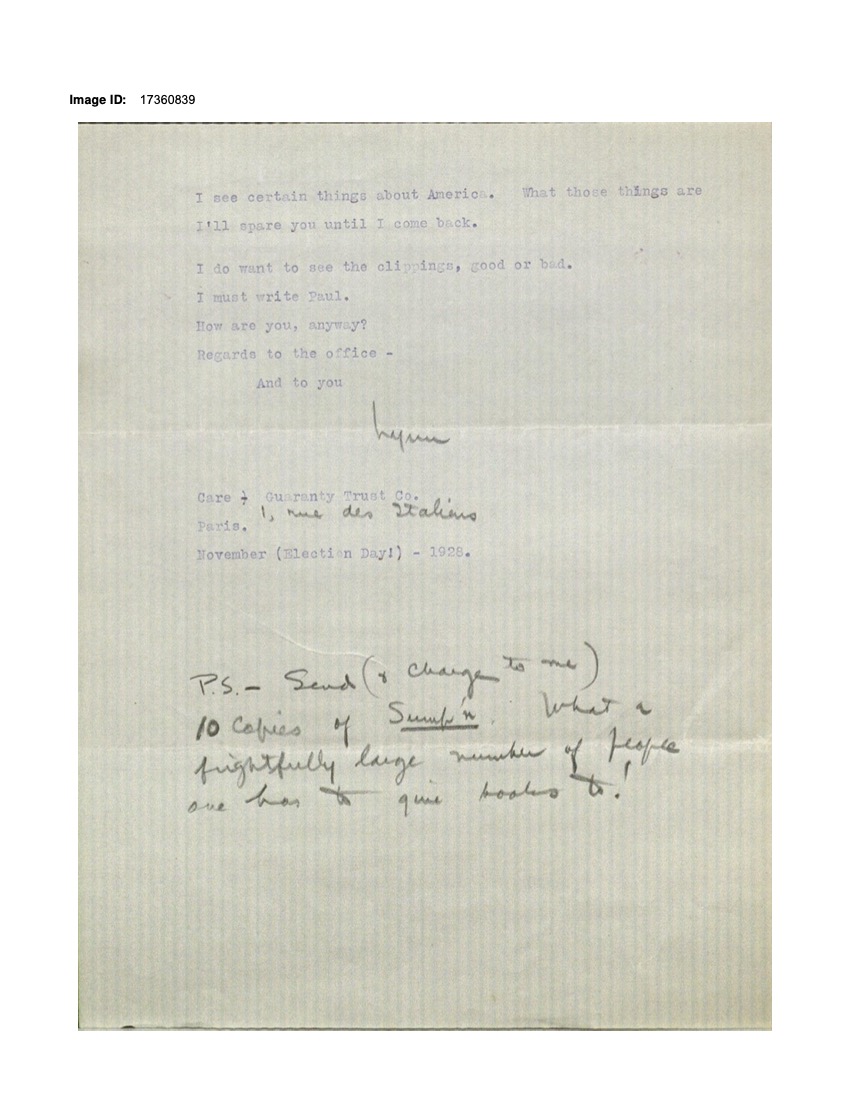
This letter to his agent, Barrett Clark, describes Riggs’s early work on both of these plays while he was on a Guggenheim Fellowship in France in 1928 and 1929. Riggs also explains his effort to represent the people of Oklahoma honestly and affectionately and ponders, as he often did in personal letters and public lectures, on the state of art and life as an artist in the interwar years in the US. Only a few years into his professional life, Riggs had become the authority on Oklahoma in the years before and after statehood and one of the leaders in the Folk Theater movement with its focus on rural and regional life. “People are always asking me about Oklahoma,” he says in the letter, not with exasperation but with some amusement and consternation. Yet he sensed that his legacy would be linked to his dramatic representations of the state’s residents: “Some day, perhaps, all the plays I will have written, taken together, may constitute a study from which certain things may emerge and be formulated into a kind of truth about people who happen to be living in Oklahoma instead of South Dakota.”
The Guggenheim was very productive for Riggs, so productive that he thought the organization might extend his fellowship. It did not. But Green Grow the Lilacs, which he describes in the letter as “a great joy to work on” and “the one of mine” he expects Clark to “like the best,” was a very popular play and made Riggs a good income for the first time in his career. Following its run on Broadway at the Guild Theatre, it went on a successful tour for two months in the Midwest and remained a popular production through the 1960s. After Rodgers and Hammerstein adapted Oklahoma! from Riggs’s play, Hammerstein wrote to the drama editor of The New York Times to say: “Mr. Riggs’ play is the wellspring of almost all that is good in Oklahoma! I kept many of the lines from the original play without making any changes in them at all for the simple reason that they could not be improved on.”
The Cherokee Night, on the other hand, was performed approximately 25 times from 1932-1936, with more than one-third of those performances at Hedgerow Theatre in Rose Valley, Pennsylvania. The play is unusual for its seven scene structure with each act set in a different time and place within the Cherokee Nation in Indian Territory and Oklahoma: 1915, 1927, 1931, 1906, 1913, 1919, and 1895. It tells the story of a group of Cherokees, in some cases from infancy to adulthood, in the turbulent years for the Indigenous nations of Indian Territory and Oklahoma that shaped the lives of Riggs and his family. It is not the only Riggs play with significant Indigenous content.
The Cherokee Night earned one glowing review. The Cleveland Plain Dealer’s long-tenured theatre critic, William F. McDermott, found the play “stronger and more powerful” than Green Grow the Lilacs and Roadside, another one of Riggs’s Broadway productions. In The Cherokee Night, McDermott observes, “[Riggs] deals with characters and scenes so authentically American as the Cherokee Indians and their descendants [. . . ] Eugene O’Neill’s plays might conceivably be written by a German or a Russian [but] Mr. Riggs’ plays could not have been written by any but an American.” McDermott recognized the play’s unconventional structure as “not coherent in the ordinary theatrical sense” but judged it “harmonious” and observed that “the separate scenes have an uncommon power to stir the imagination.” His comparison of Riggs to O’Neill likely delighted Riggs, who admired the older and more successful dramatist. Indeed, several months before sending the Election Day letter, Riggs witnessed O’Neill exiting a patisserie in Biarritz and wrote a postcard to Clark commemorating the sighting. In the letter, he lists the play as one of several short plays on which he would like to work. Four of the plays on that list became scenes in The Cherokee Night.
The letter provides a glimpse into an exciting period for Riggs: already with a following on Broadway and in the Little Theaters, he had made the pilgrimage to France, where many other writers, American and otherwise, had journeyed and become energized by the art, culture (including the vibrant café and bar scene in a country without Prohibition), and each other. He was on the cusp of national celebrity in the US and well-paid work in Hollywood, where studio executives would have kept him on their payrolls as long as we was willing. Offers of collaboration also poured in from the likes of George Gershwin, Aaron Copland, Otto Preminger, Sidney Pollack, and the dancer José Limón, among others. He says at the end of the letter, “I do want to see the clippings, good or bad.” He was predictably excited about the success of Green Grow the Lilacs, and I like to think that he would have been delighted that the National Museum of the American Indian staged the play in 2010. The sustained attention scholars now give The Cherokee Night might have baffled him, but surely would have been gratifying as well.