Letter from the Citizens of Warren County, Mississippi

to Mississippi Governor Adelbert Ames; September 14, 1875

  1. 250th Gallery
  2. Letter from the Citizens of Warren County, Mississippi

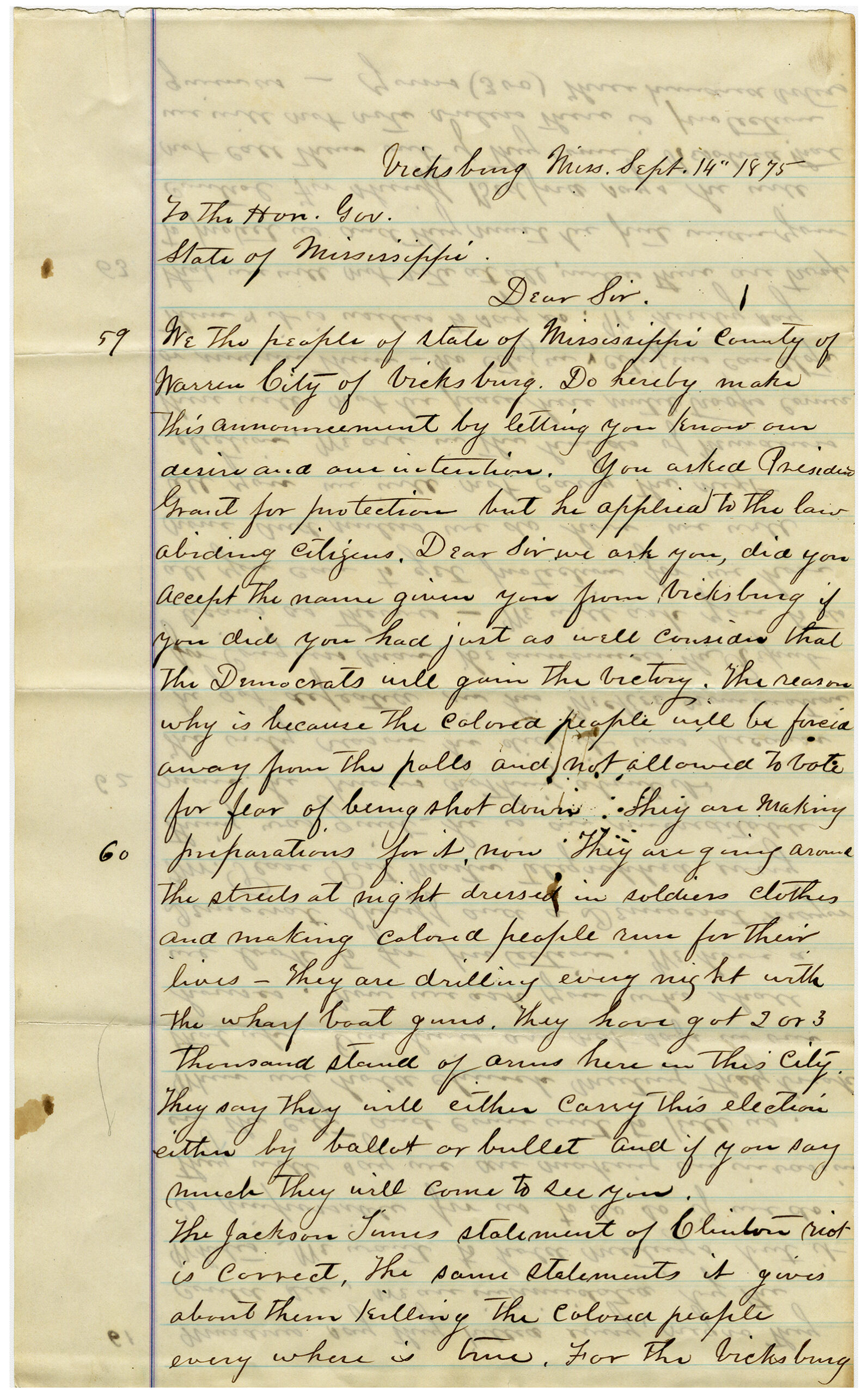
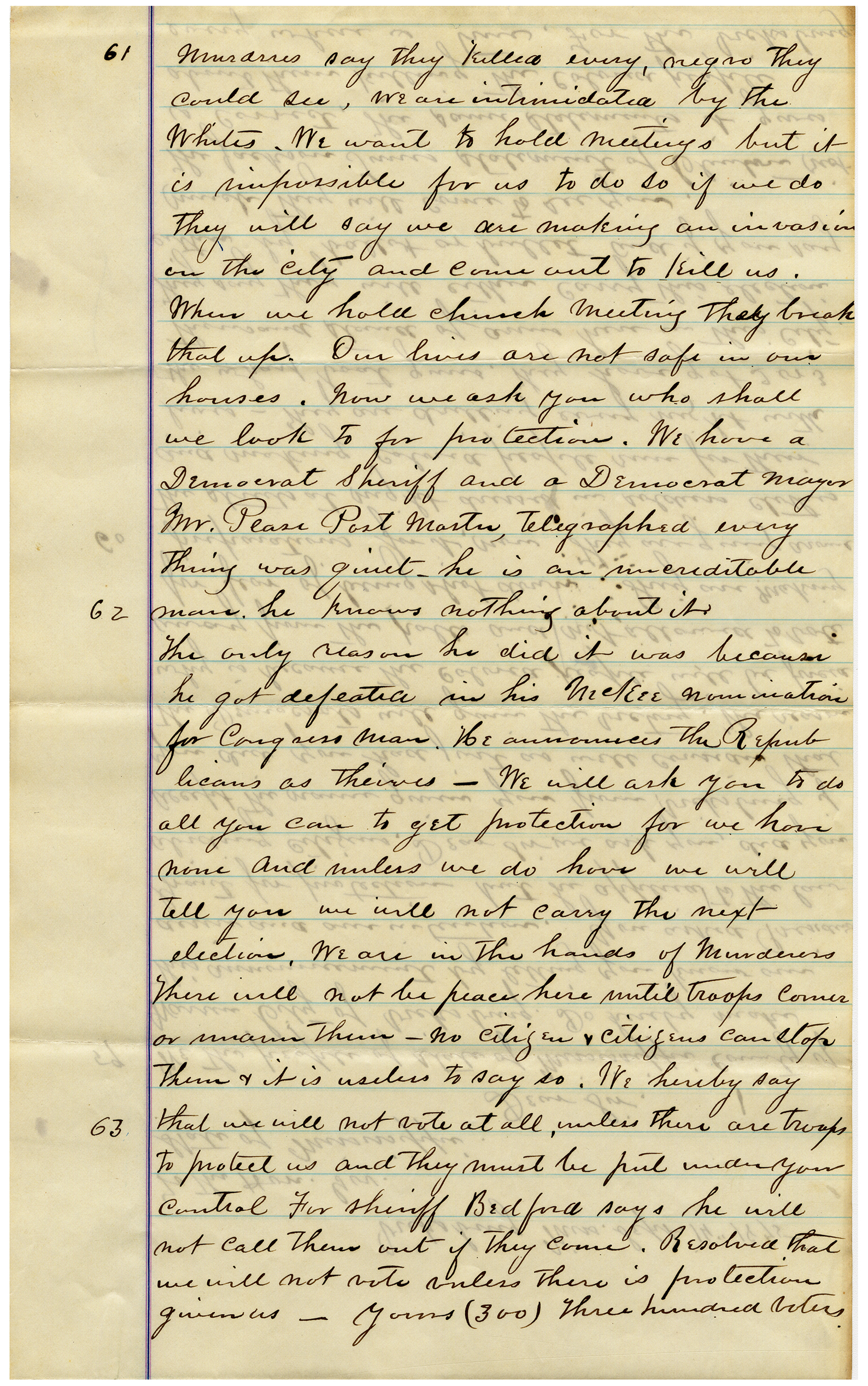
In the wake of white supremacist violence in Clinton, Mississippi, citizens of Vicksburg wrote their governor in September 1875, warning that if protection was not provided to voters, they would be “forced away from the polls and not allowed to vote.” Addressing Gov. Adelbert Ames as “We the people of [the] state of Mississippi,” the letter reveals how nineteenth-century Americans reflected on the nation’s founding, the freedoms outlined in the founding documents, and how passionately Americans felt about those freedoms nearly 100 years later. It also underscores how swiftly Americans learned to exercise their freedoms in the wake of slavery’s end, including individuals who had previously been unable to enjoy them. Finally, letters like the plea from Warren County underscore the importance of state governors’ records, which offer insights like these because Americans of every background imaginable wrote to their state executives about nearly every topic imaginable.
Read More
Document
Information
Page 1 Vicksburg Miss. Sept. 14" 1875 To the Hon. Gov. State of Mississippi. Dear Sir. (1.) ^59^ We the people of state of Mississippi County of Warren City of Vicksburg. Do hereby make this announcement by letting you know our desire and our intention. You asked President Grant for protection but he applied to the law abiding citizens. Dear Sir, we ask you, did you accept the name given you from Vicksburg if you did you had just as well consider that the Democrats will gain the victory. The reason why is because the colored people will be forced away from the polls and not allowed to vote for fear of being shot down. They are making ^60^ preparations for it, now They are going around the streets at night dressed in soldiers clothes and making colored people run for their lives—They are drilling every night with the wharf boat guns. They have got 2 or 3 thousand stand of arms here in this City. They say they will either carry this election either by ballot or bullet and if you say much they will come to see you. The Jackson Times statement of Clinton riot (2.) is correct. The same statements it gives about them killing the colored people every where is true. For the Vicksburg Page 2 ^61^ murdrres (3.) say they killed every, negro they could see, we are intimidated by the Whites. We want to hold meetings but it is impossible for us to do so if we do they will say we are making an invasion on the city and come out to kill us. When we hold church meeting they break that up. Our lives are not safe in our houses. Now we ask you who shall we look to for protection. We have a Democrat Sheriff (4). and a Democrat Mayor (5.) Mr. Pease Post Master, telegraphed every thing was quiet—he is an uncreditable ^62^ man. he knows nothing about it. The only reason he did it was because he got defeated in his McKee nomination for Congressman. He announces the Repub-licans as theives—We will ask you to do all you can to get protection for we have none and unless we do have we will tell you we will not carry the next election. We are in the hands of murderers There will not be peace here until troops come or unarm them—no citizen & citizens can stop them & it is useless to say so. We hereby say ^63^ that we will not vote at all, unless there are troops to protect us and they must be put under your control For sheriff Bedford says he will not call them out if they come. Resolved that we will not vote unless there is protection given us—Yours (300) Three hundred voters.

Notes & Annotations

  1. Adelbert Ames (1835-1933) served as a governor and U.S. senator of Mississippi during the Reconstruction era. In 1868, he was appointed the provisional governor of Mississippi and served until 1870. Ames proved sympathetic to the plight of African Americans in the South. He sought to protect Black civil rights and appointed Mississippi’s first African American public officials. In 1870, after Mississippi was readmitted into the Union, Ames ran for U.S. senator for the state as a Republican and won, serving from February 1870 to January 1874. In 1874, Ames was elected to the Governor’s office and served until his resignation in March 1876.
  2. The Clinton Massacre of 1875 embodied the violent racial politics that spelled the end of Reconstruction in Mississippi. In preparation for that November's elections, Mississippi's Republican Party scheduled political rallies throughout the state to be held on September 4, 1875, one of which was to be at Clinton, Mississippi, roughly ten miles west of the state capital at Jackson. As a token of good faith, the Republicans invited Democratic speakers to the rally as well. Political rallies in the nineteenth century often featured large barbecues, impassioned speakers, and generous portions of alcohol, and the rally at Clinton was no different. While the organizers banned alcohol from the premises, the roughly seventy-five whites out of an estimated 1,500-2,500 people in attendance brought it anyway. Democratic speaker Amos R. Johnston spoke in peace, yet Republican H. T. Fisher faced hecklers in the crowd. Despite efforts to cool tensions, whites in attendance (members of the racist paramilitary White Line group) opened fire on the crowd. Chaos ensued and left three whites and five Blacks, including two children, dead. The violence continued over the next few weeks, as White Liners massacred and lynched Black and white Republicans in the area regardless of their participation in the Clinton rally. The Clinton Riot opened what white Democrats dubbed the "Mississippi Plan" in which white Democrats would resort to widespread violence in order to remove African Americans and Republicans generally from the state's electoral politics. President Ulysses S. Grant famously refused to send federal aid to restore order to Mississippi's capital, signaling the retreat of the federal government from protecting the rights of African Americans won through the Civil War and Reconstruction. The Clinton Massacre thereby represents an episode of mass racial violence targeted at African Americans that signaled the nation's growing complicity in the development of what would become the Jim Crow system of segregation.
  3. The Vicksburg Massacre occurred on December 7, 1874, in Vicksburg, Mississippi. Many African American men and women gained both social and financial influence during the Reconstruction era that would have been impossible in antebellum Mississippi. In Warren County, as throughout the state, Black citizens in public office spent tax money on universal public education and infrastructure, both of which benefited white citizens as well as Black. However, many conservative whites reacted strongly to the gains of African Americans, particularly their challenges to an economic and social system formerly dominated by whites. White citizens of Vicksburg responded by creating the "Taxpayer's League," to ostensibly protest the misuse of county taxes. In reality, these groups protested any act of African-American leadership or progress. Consequently, when Peter Crosby, an African American man and Union veteran, was elected sheriff of Warren County, Mississippi, on November 4, 1873, white Warren County residents looked for reasons to depose him. After one year of service as sheriff, whites of the Taxpayer's League surrounded the Warren County courthouse on December 2, 1874, to expel Crosby from office. Crosby surrendered, yet he returned on December 7 with other Black citizens of Warren County to reinstate the duly elected sheriff. A crowd of whites met Crosby at the courthouse and demanded that he and his mostly unarmed supporters return home. When many complied and turned for home, the whites around the courthouse opened fire, killing several Black men. Other white mobs also rioted upon hearing this news, killing innocent African Americans over several days in what became known as the "Vicksburg Massacre." The U.S. government sent in armed forces to restore order, reinstating Crosby as sheriff soon after. The Vicksburg Massacre represented an increasingly violent turn in Reconstruction politics, as racist insurrectionists turned more frequently to episodes of mass racial violence to accomplish their political, economic, and social aims.
  4. Thomas Cutler Bedford, Sr. (1827-1919) was a white merchant, broker, planter, and former Confederate soldier who briefly served as Chief Deputy under Warren County Sheriff Peter Crosby during Mississippi Reconstruction. Born in Warrenton, Mississippi, Bedford spent the 1850s farming in Louisiana before establishing himself in Vicksburg by 1860 as a merchant and broker. Census records indicate that in 1850 Bedford enslaved fifty-two people while living in Louisiana, but by the time he returned to Mississippi, records show that he enslaved four people. Later sources described him as a wealthy planter. After Sheriff Crosby dismissed his previous deputy following corruption allegations and survived an assassination attempt in 1875 by him, Crosby hired Bedford as his Chief Deputy amid escalating racial and political tensions surrounding Crosby’s position as one of Mississippi’s few Black sheriffs during Reconstruction. Described as a Democrat, Bedford had previously enlisted as a private in the Confederate Army’s 1st Louisiana Heavy Artillery, though later references to him as “Major Bedford” suggest he may have later held officer status.
  5. Richard O'Leary (1838-1918) was a widower and Confederate veteran.

Institution(s):
  • Institutions: Mississippi State University, University of South Dakota, Mississippi Digital Library, Mississippi Department of Archives & History
  • Funders: National Endowment for the Humanities and National Historical Publications and Records Commission
Editor(s):

Susannah J. Ural, Ph.D. and Lindsey R. Peterson, Ph.D.

Source Note

Citizens of Warren County (Miss.), “Letter from the Citizens of Warren County, Mississippi, to Mississippi Governor Adelbert Ames; September 14, 1875,” Mississippi Department of Archives and History, Ames Series 803: Box 997, Folder 6 in Civil War & Reconstruction Governors of Mississippi, accessed August 19, 2026, https://cwrgm.org/item/mdah_803-997-06-12.

Editorial Process & Document History

This document first went through digitization and verification at the Mississippi Department of Archives and History, followed by the creation and review of its metadata to ensure the digital file was accurately described and organized. It was then transcribed and enriched with subject tags and annotations, with each stage reviewed by trained team members and final checks by project editors.

Additional Details

This document is part of the Civil War & Reconstruction Governors of Mississippi scholarly edition (CWRGM). CWRGM is digitizing, transcribing, and annotating these valuable records from Mississippi’s governors’ offices and making them freely available online. The project covers nine administrations, beginning amid rumblings of secession in late 1859, continuing through civil war, emancipation, occupation, and Reconstruction, ending in the early Jim Crow South in 1882. 


Thanks to the diverse nature of this collection, CWRGM documents touch on nearly every topic imaginable. These include questions of loyalty and dissent, the process of emancipation and the changing definition of citizenship, and military experiences that ranged from state militias to Confederate national service to the role of nearly 20,000 Mississippians who served in the Union Army and Navy. The collections also contribute to ongoing debates about Civil War memory and commemoration, and help users explore the question of whose experiences are preserved and how, and whose are ignored or erased.

The Association for Documentary Editing

The ADE brings historical documents to life by helping editors preserve, interpret, and share important records from the past with the public.