Lynn Riggs to Barrett Clark, Election Day Letter, 1928

  1. 250th Gallery
  2. Lynn Riggs to Barrett Clark, Election Day Letter, 1928

The Cherokee dramatist Lynn Riggs, the author of six plays produced on Broadway, was born in the Cherokee Nation, Indian Territory, in 1899, a decade into the land runs that led to the loss of millions of acres of Indigenous land. Soon after his eighth birthday in 1907, and following the implementation of the General Allotment and Curtis Acts in the Indigenous nations of Indian Territory, Oklahoma became a state, and those Indigenous nations saw the dissolution of their governments. Riggs set many of his plays in the Cherokee Nation, including Green Grow the Lilacs (1931), the source play for Oklahoma! (1943), the first collaboration between the legendary Broadway musical team Rodgers and Hammerstein. Riggs wrote his most explicitly Cherokee play, The Cherokee Night (1932), during the same period that he wrote Green Grow the Lilacs. Green Grow the Lilacs has been until recently the most well-known of his plays to both theater aficionados and drama scholars. But since the mid-1990s, The Cherokee Night has earned the most attention from scholars in Native American and Indigenous Studies as part of the recovery efforts that have so remarkably expanded our understanding of Native American literary history before the publication of Kiowa author N. Scott Momaday’s novel House Made of Dawn in 1968 initiated the Native American Renaissance.

This letter to his agent, Barrett Clark, describes Riggs’s early work on both of these plays while he was on a Guggenheim Fellowship in France in 1928 and 1929. Riggs also explains his effort to represent the people of Oklahoma honestly and affectionately and ponders, as he often did in personal letters and public lectures, on the state of art and life as an artist in the interwar years in the US. Only a few years into his professional life, Riggs had become the authority on Oklahoma in the years before and after statehood and one of the leaders in the Folk Theater movement with its focus on rural and regional life. “People are always asking me about Oklahoma,” he says in the letter, not with exasperation but with some amusement and consternation. Yet he sensed that his legacy would be linked to his dramatic representations of the state’s residents: “Some day, perhaps, all the plays I will have written, taken together, may constitute a study from which certain things may emerge and be formulated into a kind of truth about people who happen to be living in Oklahoma instead of South Dakota.”

The Guggenheim was very productive for Riggs, so productive that he thought the organization might extend his fellowship. It did not. But Green Grow the Lilacs, which he describes in the letter as “a great joy to work on” and “the one of mine” he expects Clark to “like the best,” was a very popular play and made Riggs a good income for the first time in his career. Following its run on Broadway at the Guild Theatre, it went on a successful tour for two months in the Midwest and remained a popular production through the 1960s. After Rodgers and Hammerstein adapted Oklahoma! from Riggs’s play, Hammerstein wrote to the drama editor of The New York Times to say: “Mr. Riggs’ play is the wellspring of almost all that is good in Oklahoma! I kept many of the lines from the original play without making any changes in them at all for the simple reason that they could not be improved on.”

The Cherokee Night, on the other hand, was performed approximately 25 times from 1932-1936, with more than one-third of those performances at Hedgerow Theatre in Rose Valley, Pennsylvania. The play is unusual for its seven scene structure with each act set in a different time and place within the Cherokee Nation in Indian Territory and Oklahoma: 1915, 1927, 1931, 1906, 1913, 1919, and 1895. It tells the story of a group of Cherokees, in some cases from infancy to adulthood, in the turbulent years for the Indigenous nations of Indian Territory and Oklahoma that shaped the lives of Riggs and his family. It is not the only Riggs play with significant Indigenous content.

The Cherokee Night earned one glowing review. The Cleveland Plain Dealer’s long-tenured theatre critic, William F. McDermott, found the play “stronger and more powerful” than Green Grow the Lilacs and Roadside, another one of Riggs’s Broadway productions. In The Cherokee Night, McDermott observes, “[Riggs] deals with characters and scenes so authentically American as the Cherokee Indians and their descendants [. . . ] Eugene O’Neill’s plays might conceivably be written by a German or a Russian [but] Mr. Riggs’ plays could not have been written by any but an American.” McDermott recognized the play’s unconventional structure as “not coherent in the ordinary theatrical sense” but judged it “harmonious” and observed that “the separate scenes have an uncommon power to stir the imagination.” His comparison of Riggs to O’Neill likely delighted Riggs, who admired the older and more successful dramatist. Indeed, several months before sending the Election Day letter, Riggs witnessed O’Neill exiting a patisserie in Biarritz and wrote a postcard to Clark commemorating the sighting. In the letter, he lists the play as one of several short plays on which he would like to work. Four of the plays on that list became scenes in The Cherokee Night.

The letter provides a glimpse into an exciting period for Riggs: already with a following on Broadway and in the Little Theaters, he had made the pilgrimage to France, where many other writers, American and otherwise, had journeyed and become energized by the art, culture (including the vibrant café and bar scene in a country without Prohibition), and each other. He was on the cusp of national celebrity in the US and well-paid work in Hollywood, where studio executives would have kept him on their payrolls as long as we was willing. Offers of collaboration also poured in from the likes of George Gershwin, Aaron Copland, Otto Preminger, Sidney Pollack, and the dancer José Limón, among others. He says at the end of the letter, “I do want to see the clippings, good or bad.” He was predictably excited about the success of Green Grow the Lilacs, and I like to think that he would have been delighted that the National Museum of the American Indian staged the play in 2010. The sustained attention scholars now give The Cherokee Night might have baffled him, but surely would have been gratifying as well.
Read More
Document
Information

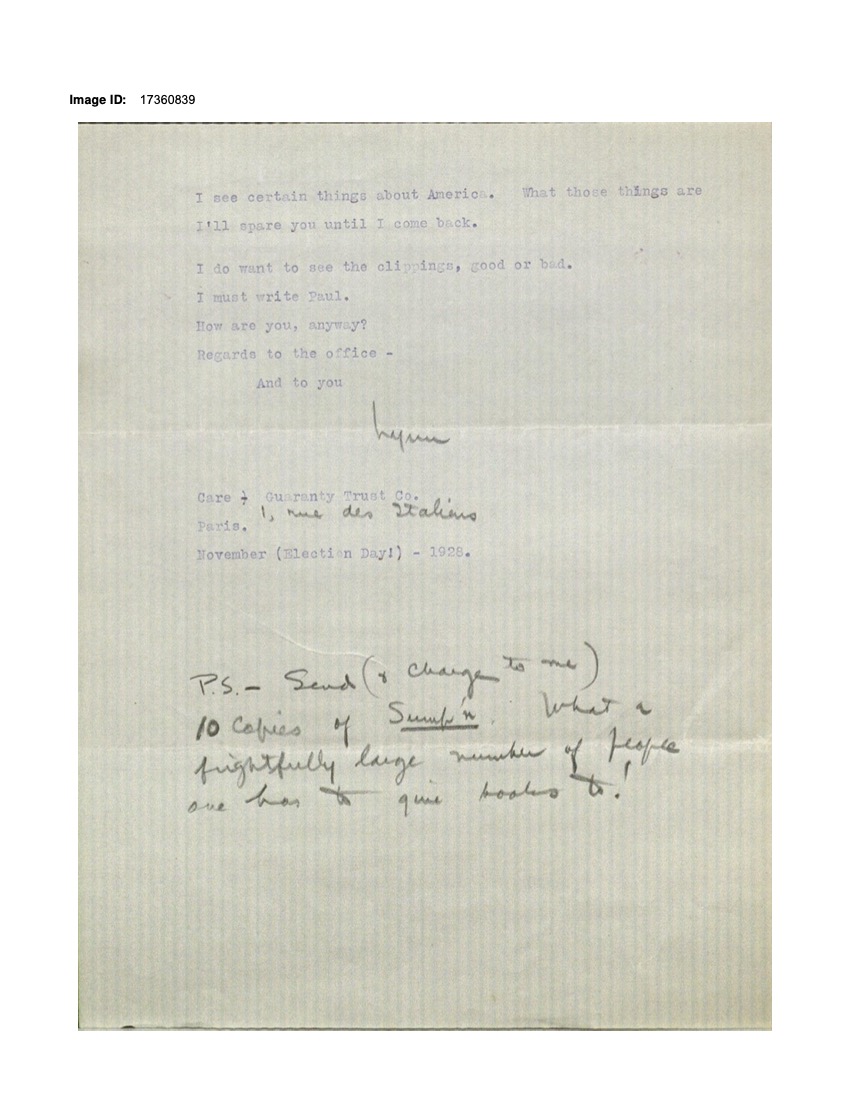
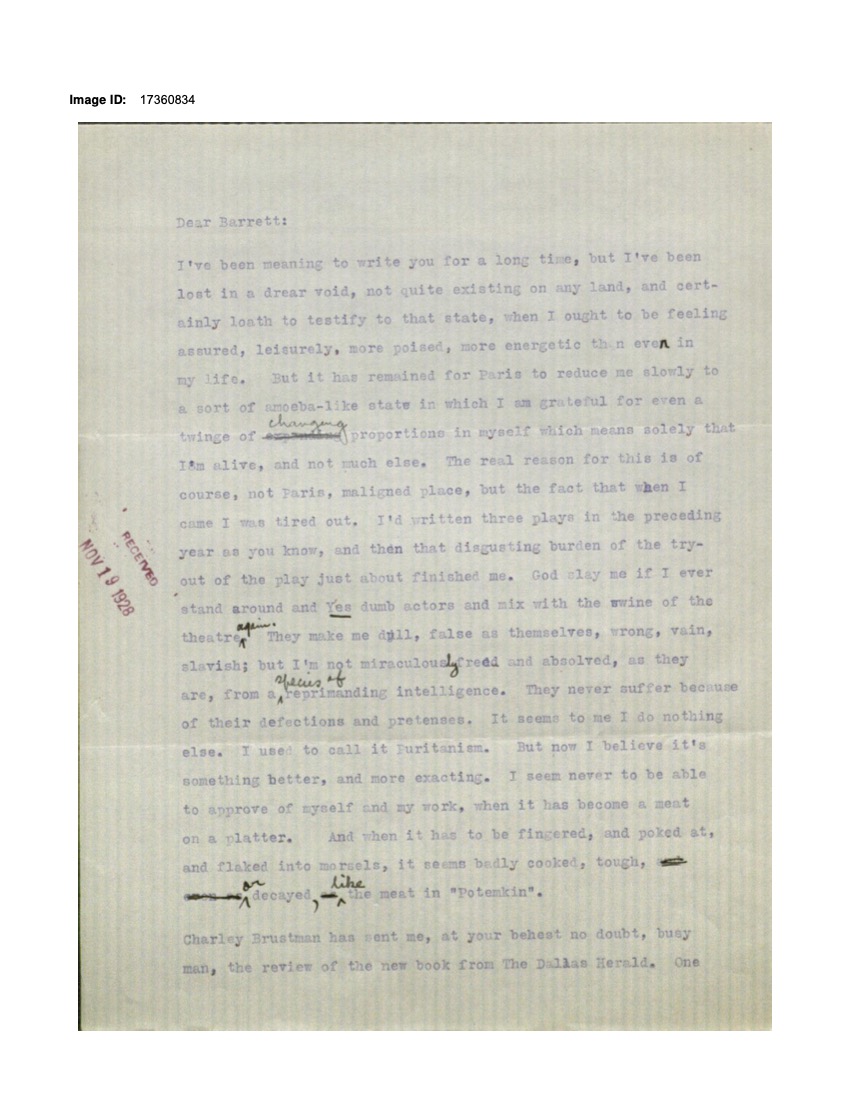
[stamped in left margin: RECEIVED NOV 19 1928]

Dear Barrett:

I’ve been meaning to write you for a long time, but I’ve been lost in a drear void, not quite existing on any land, and certainly loath to testify to that state, when I ought to be feeling assured, leisurely, more poised, more energetic than ever in my life. But it has remained for Paris to reduce me slowly to a sort of amoeba-like state in which I am grateful for even a twinge of expanding changing proportions in myself which means solely that I’m alive, and not much else. The real reason for this is of course, not Paris, maligned place, but the fact that when I came I was tired out. I’d written three plays in the preceding year as you know, and then that disgusting burden of the tryout of the play just about finished me. God slay me if I ever stand around and Yes dumb actors and mix with the swine of the theatre again.They make me dull, false as themselves, wrong, vain, slavish; but I’m not miraculously freed and absolved, as they are, from a species of reprimanding intelligence. They never suffer because of their defections and pretenses. It seems to me I do nothing else. I used to call it Puritanism. But now I believe it’s something better, and more exacting. I seem never to be able to approve of myself and my work, when it has become a meat on a platter. And when it has to be fingered, and poked at, and flaked into morsels, it seems badly cooked, tough, and even as or decayed, as like the meat in “Potemkin”.

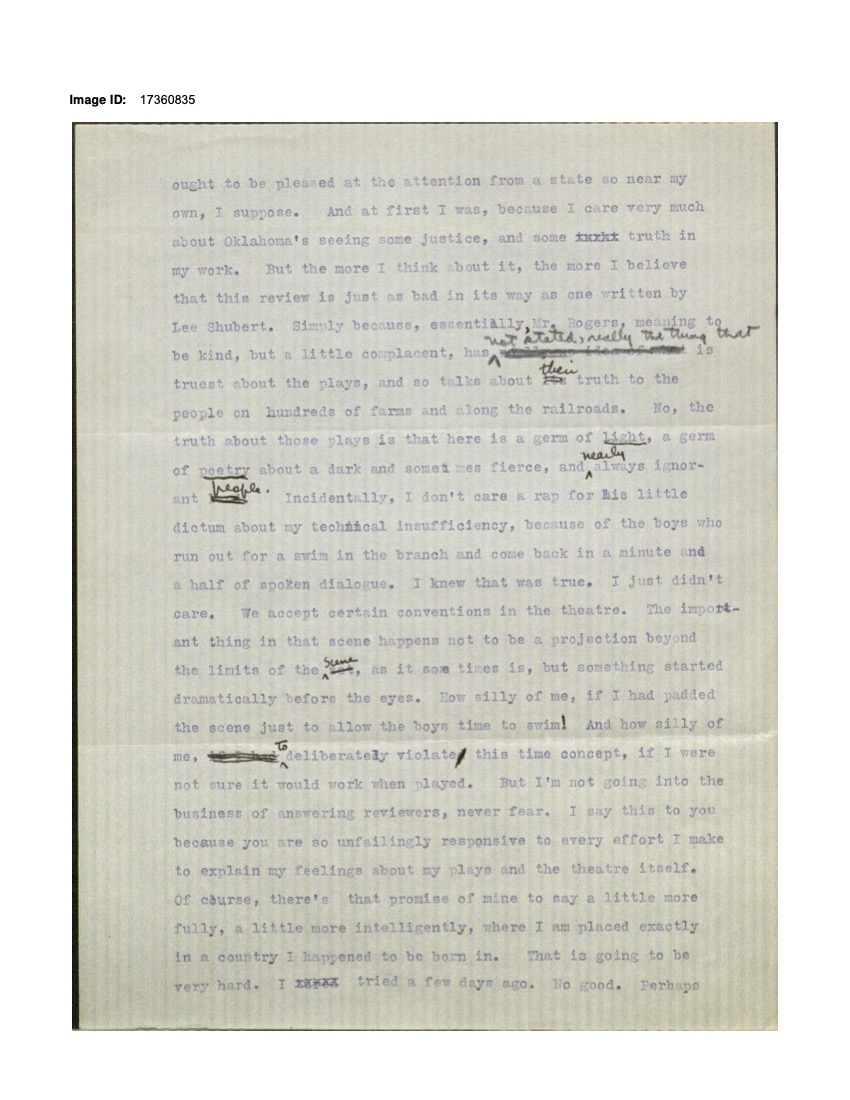
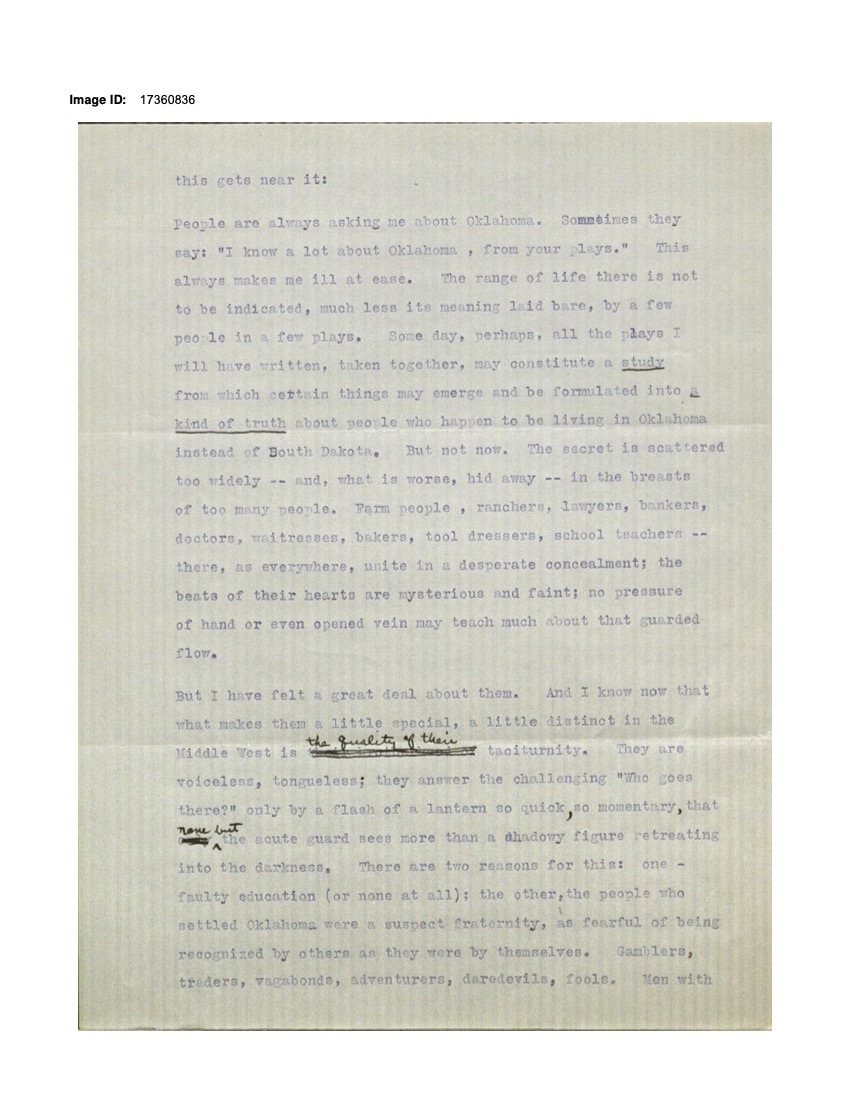
Charley Brustman has sent me, at your behest no doubt, busy man, the review of the new book from The Dallas Herald. One ought to be pleased at the attention from a state so near my own, I suppose. And at first I was, because I care very much about Oklahoma’s seeing some justice, and some truth in my work. But the more I think about it, the more I believe that this review is just as bad in its way as one written by Lee Shubert. Simply because, essentially, Mr. Rogers, meaning to be kind, but a little complacent, has really no idea of what not stated, really the thing that is truest about the plays, and so talks about its their truth to the people on hundreds of farms and along the railroads. No, the truth about those plays is that here is a germ of light, a germ of poetry about a dark and sometimes fierce, and nearly always ignorant land people. Incidentally, I don’t care a rap for his little dictum about my technical insufficiency, because of the boys who run out for a swim in the branch and come back in a minute and a half of spoken dialogue. I knew that was true. I just didn’t care. We accept certain conventions in the theatre. The important thing in that scene happens not to be a projection beyond the limits of the set scene, as it sometimes is, but something started dramatically before the eyes. How silly of me, if I had padded the scene just to allow the boys time to swim! And how silly of me, if I had to deliberately violated this time concept, if I were not sure it would work when played. But I’m not going into the business of answering reviewers, never fear. I say this to you because you are so unfailingly responsive to every effort I make to explain my feelings about my plays and the theatre itself. Of course, there’s that promise of mine to say a little more fully, a little more intelligently, where I am placed exactly in a country I happened to be born in. That is going to be very hard. I tried a few days ago. No good. Perhaps this gets near it:

People are always asking me about Oklahoma. Sometimes they say: “I know a lot about Oklahoma, from your plays.” This always makes me ill at ease. The range of life there is not to be indicated, much less its meaning laid bare, by a few people in a few plays. Some day, perhaps, all the plays I will have written, taken together, may constitute a study from which certain things may emerge and be formulated into a kind of truth about people who happen to be living in Oklahoma instead of South Dakota. But not now. The secret is scattered too widely — and, what is worse, hid away — in the breasts of too many people. Farm people, ranchers, lawyers, bankers, doctors, waitresses, bakers, tool dressers, school teachers — there, as everywhere, unite in a desperate concealment; the beats of their hearts are mysterious and faint; no pressure of hand or even opened vein may teach much about that guarded flow.

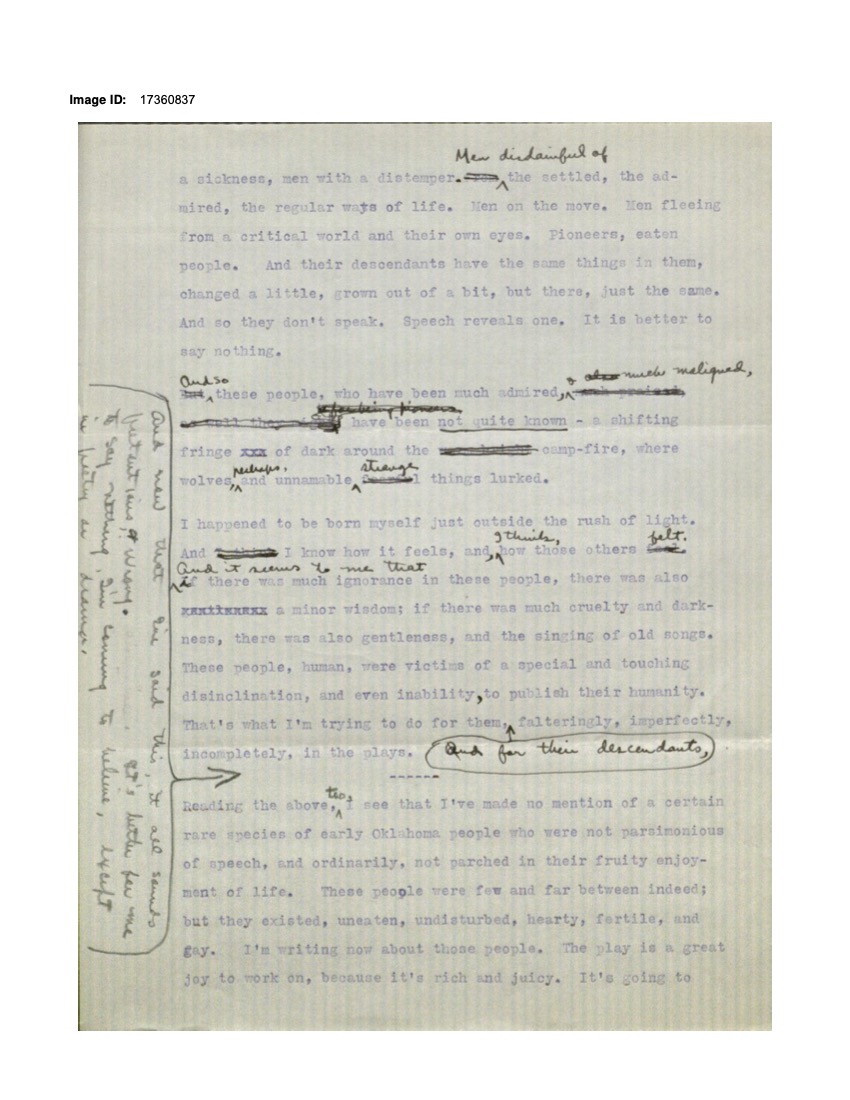
But I have felt a great deal about them. And I know now that what makes them a little special, a little distinct in the Middle West is their brotherhood of the quality of their taciturnity. They are voiceless, tongueless; they answer the challenging “Who goes there?” only by a flash of a lantern so quick, so momentary, that only none but the acute guard sees more than a shadowy figure retreating into the darkness. There are two reasons for this: one — faulty education (or none at all); the other, the people who settled Oklahoma were a suspect fraternity, as fearful of being recognized by others as they were by themselves. Gamblers, traders, vagabonds, adventurers, daredevils, fools. Men with a sickness, men with a distemper. from Men disdainful of the settled, the admired, the regular ways of life. Men on the move. Men fleeing from a critical world and their own eyes. Pioneers, eaten people. And their descendants have the same things in them, changed a little, grown out of a bit, but there, just the same. And so they don’t speak. Speech reveals one. It is better to say nothing.

But And so these people, who have been much admired, much praised, as well as they might for being pioneers, and much maligned, have been not quite known — a shifting fringe of dark around the ??? bright camp-fire, where wolves, perhaps, and unnamable fearful strange things lurked.

I happened to be borned myself just outside the rush of light. And I think I know how it feels, and, I think, how those others feel felt. And it seems to me that if there was much ignorance in the people, there was also a minor wisdom; if there was much cruelty and darkness, there was also gentleness, and the singing of old songs. These people, human, were victims of a special and touching disinclination, and even inability, to publish their humanity. That’s what I’m trying to do for them, and for their descendants, falteringly, imperfectly, incompletely, in the plays. [And now that I’ve said this, it all sounds pretentious, and wrong. It’s better for me to say nothing, I’m coming to believe, except in poetry as drama.]

——————

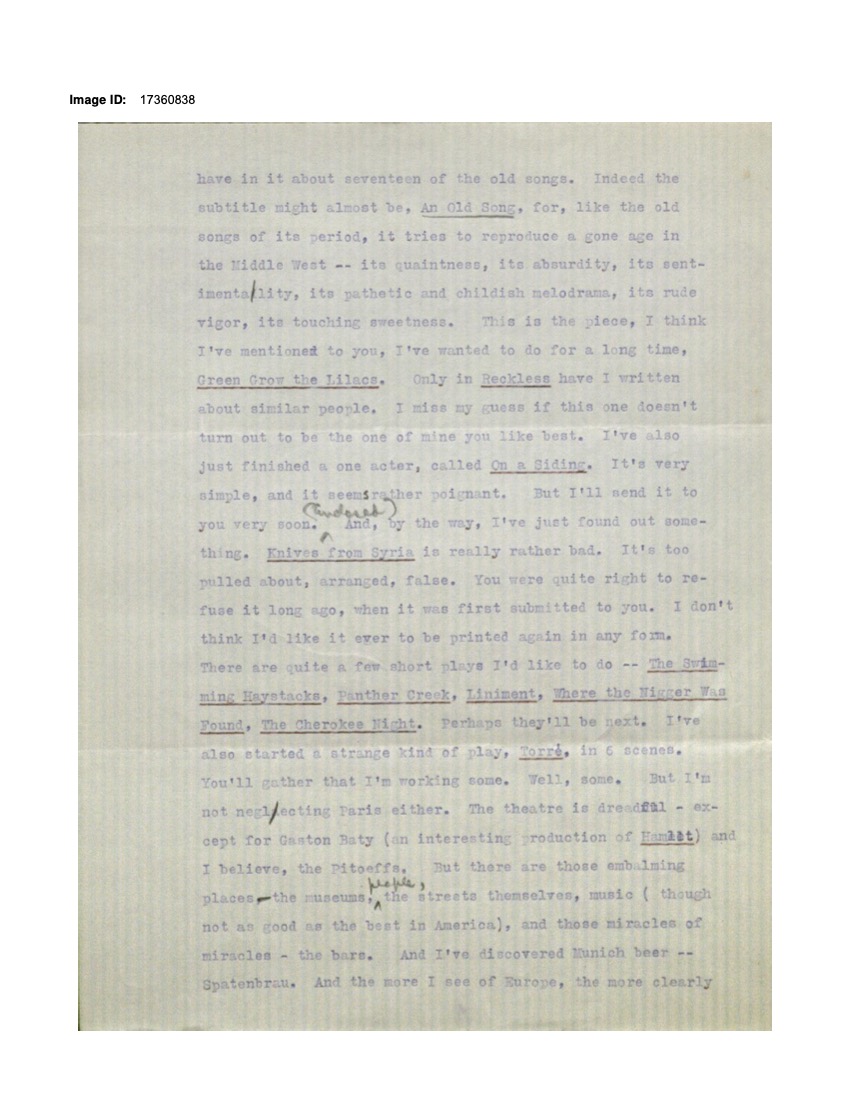
Reading the above, too, I see that I’ve made no mention of a certain rare species of early Oklahoma people who were not parsimonious of speech, and ordinarily, not parched in their fruity enjoyment of life. These people were few and far between indeed; but they existed, uneaten, undisturbed, hearty, fertile, and gay. I’m writing now about those people. The play is a great joy to work on, because it’s rich and juicy. It’s going to have in it about seventeen of the old songs. Indeed the subtitle might almost be, An Old Song, for, like the old songs of its period, it tries to reproduce a gone age in the Middle West — its quaintness, its absurdity, its sentimentality, its pathetic and childish melodrama, its rude vigor, its touching sweetness. This is the piece, I think I’ve mentioned to you, I’ve wanted to do for a long time, Green Grow the Lilacs. Only in Reckless have I written about similar people. I miss my guess if this one doesn’t turn out to be the one of mine you like best. I’ve also just finished a one acter, called On a Siding. It’s very simple, and it seems rather poignant. But I’ll send it to you very soon. (enclosed) And, by the way, I’ve just found out something. Knives from Syria is really rather bad. It’s too pulled about, arranged, false. You were quite right to refuse it long ago, when it was first submitted to you. I don’t think I’d like it ever to be printed again in any form. There are quite a few short plays I’d like to do — The Swimming Haystacks, Panther Creek, Liniment, Where the N- - - - - Was Found, The Cherokee Night. Perhaps they’ll be next. I’ve also started a strange kind of play, Torré, in 6 scenes. You’ll gather that I’m working some. Well, some. But I’m not neglecting Paris either. The theatre is dreadful — except for Gaston Baty (an interesting production of Hamlet) and I believe, the Pitoeffs. But there are those embalming places — the museums, people, the streets themselves, music (though not as good as the best in America), and those miracles of miracles — the bars. And I’ve discovered Munich beer — Spatenbrau. And the more I see of Europe, the more clearly I see certain things about America. What those things are I’ll spare you until I come back.

I do want to see the clippings, good or bad.

I must write Paul.

How are you, anyway?

Regards to the office —

            And to you

                                  Lynn [signed in pencil]

Care — Guaranty Trust Co.

1, rue des Italiens

Paris.

November (Election Day!) — 1928.

[added in pencil]

P.S. — Send (and charge to me) 10 copies of Sump’n. What a frightfully large number of people one has to give books to!

Editor(s):

James Cox, Election Day Letter

Alexander Pettit, Indigenous Plays and Cuckoo! (in progress)

Jonathan Radocay, Cuckoo! (in progress)

Source Note

The Beinecke Library at Yale University holds this letter in the Lynn Riggs Papers, Series 1: Correspondence, 1927-1940, Barrett Clark, Box 5, YCAL MSS 569.

Thank you to the Lynn Riggs family and Barbara Hogenson of the Barbara Hogenson Agency, the representative of the Lynn Riggs literary estate, for their permission to publish this letter.

Editorial Process & Document History

The transcription accounts for the typed and handwritten text, including where Riggs used a pencil to strike through typed text and inserted edits. The deleted text appears before the edits or revisions, thus: expanding changing, or much praised, as well as they might for being pioneers, and much maligned, have been not quite known. In one case, marked ???, the text beneath the pencil strike is unreadable. Riggs used xxx to delete several passages, which have not been transcribed. The transcription regularizes his use of dashes, making both one or two into an m-dash with a space to both sides per Riggs’s style.

Additional Details

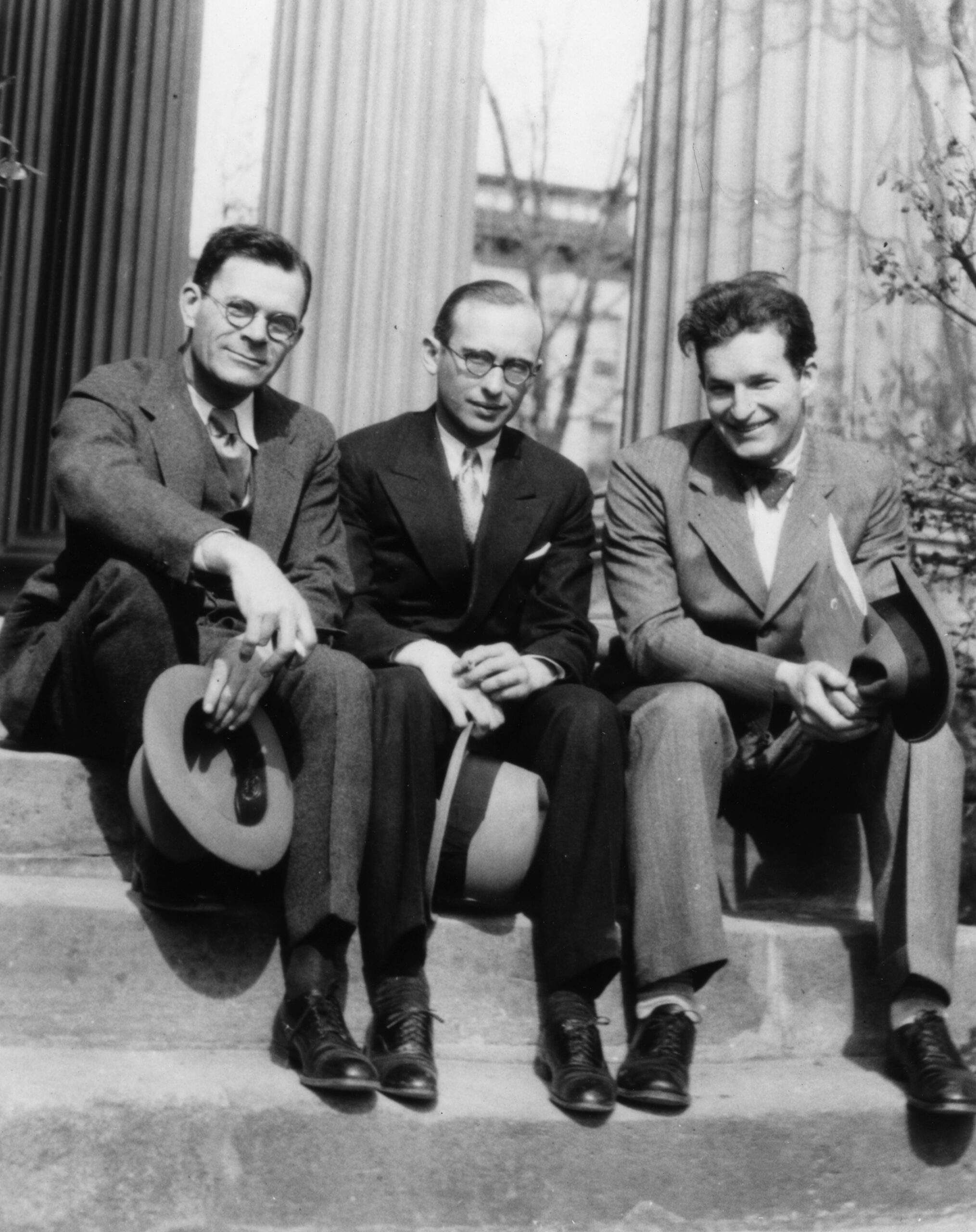
Caption for the photo: Barrett Clark with Lynn Riggs and fellow dramatist and Samuel French client Paul Green at the University of North Carolina at Chapel Hill’s Playmakers Theatre, February 13, 1931, about three weeks after Green Grow the Lilacs opened on Broadway at the Guild Theatre.

With permission of

the Paul Green Foundation

Serving the Arts and Human Rights since 1982

Chapel Hill, North Carolina

The Association for Documentary Editing

The ADE brings historical documents to life by helping editors preserve, interpret, and share important records from the past with the public.