
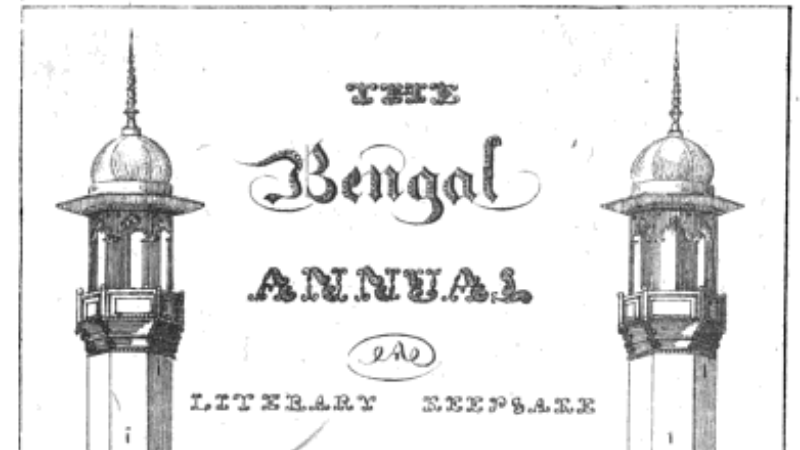
Participants discuss the decolonial strategies employed in a graduate student collaborative Digital Humanities project, The Bengal Annual: A Digital Exploration of Non-Canonical British Romantic Literature, and the archival project “Letters from Harriet Noyes: Missionaries and Women’s Education in 19th-Century China,” an endeavor that is supported by an undergraduate team.
Moderator: Kenneth M. Price, co-director, The Walt Whitman Archive, co-editor, The Charles W. Chesnutt Archive, University of Nebraska-Lincoln.
Katherine D. Harris, San José State University: “Revolution through Recovery: SJSU #bigger 6 Digital Edition of The Bengal Annual for 1830”
During Spring 2019, five graduate students agreed to eschew the exclusivity of the canonical list of Byron, Keats, Shelley, Wordsworth, Coleridge and Blake in order to tackle British Romanticism from a more diverse and engaged perspective, a perspective that reflected their own identities and subject positions. With most of the students already working in the K-12 public school system, the readings and activities would offer them a way into the Industrial Revolution and violent colonialism without necessarily adhering to the rules of valorizing an all-white, male literary menu. After crafting a reading list together, they delved into canonical and non-canonical literature, read historical accounts of the British Empire, interrogated key concepts like Orientalism/nature/beauty/sublime, analyzed rare materials, unearthed the importance of women’s authorship, embraced a literary recovery project, dabbled in computational analysis methods, and engaged in the creation of a collaborative Digital Humanities project: The Bengal Annual: A Digital Exploration of Non-Canonical British Romantic Literature http://scalar.usc.edu/works/the-bengal-annual/index
The further these students developed their digital edition of the 1830 literary annual, The Bengal Annual, published in Calcutta, the more they realized that the British editor, who declared all “local” engravers and poets to offer nothing more than doggeral verse and hackneyed images of India, the more they realized how much comparative literary annuals, such as The Oriental Annual, created a voyeuristic, exotic, and violent representation of India for consumption by London reading publics exclusively. The few engravings and “local” poets included in the 1830 Bengal Annual, though, instead seemed to steer away from being hybrids or offering mimicry or even pushing revolution. Instead, they watched as these poets and engravers developed their own styles and subsumed the British colonial traditions into the long-standing Indian literary history to create something new. In essence, the students (and I) stopped studying British Romanticism in India and instead began revising Romanticism based on India’s revising the movement. Because the newly-public version of Scalar offered multiple plug-ins (e.g., Hypothes.is and Internet Archive), they were able to grab hold of Digital Humanities strategies (e.g., visualizing topic modeling and exploring word vectors) to deeply interrogate these 300 pages of prose, poetry, and engravings.
The course didn’t set out to be revolutionary, but by the semester’s end, participants felt like they had accomplished a form of social justice beyond merely pointing towards a recovery project.

Katherine D. Harris
Katherine D. Harris (@triproftri) is a Professor of Literature & Digital Humanities in the Department of English and Comparative Literature, San José State University, where she teaches about literature and technology ranging from the mechanization of the printing press in 19th-century England to current uses of narrative in gaming. In collaboration with co-editors with Matthew K. Gold, Rebecca Frost Davis, and Jentery Sayers, she is finalizing Digital Pedagogy in the Humanities, an open access digital publication being published with the Modern Language Association that curates over 700 assignments, syllabi and other examples of digital pedagogy. While her traditional scholarship focuses on three history of the book and textual scholarly studies surrounding 19th-century British literary annuals (Forget Me Not: The Rise of the British Literary Annual 1823- 1835, Ohio UP 2015; The Forgotten Gothic: Short Stories from British Annuals 1823-1831, Zittaw Press 2012; and The Forget Me Not: A Hypertextual Archive), she has long been an advocate for Digital Pedagogy, especially at less well-resourced institutions. As part of that advocacy, Katherine chaired the California Open Educational Resources Council (White Paper, 2016) which oversaw a state-wide program to implement OER into the 123 CSU, UC, and community college campuses. Find more about her work at https://triproftri.wordpress.com/
Catherine Heil, Marloes Krabbe, and Denise Monbarren, College of Wooster: “Countering Imperialist Narratives through Project Design: Creating the ‘Letters from Harriet Noyes’ Collection”
Harriet Noyes was a nineteenth-century American missionary and educator in China, and for the past two years, a small team at The College of Wooster, composed mostly of undergraduate students, has worked to digitize, transcribe, and provide access to a large collection of her papers. Because her letters portray Chinese history at the turn of the century through an Imperialist lens, our work, funded by a CLIR Hidden Collections grant, not only provides access to digital surrogates of Harriet’s papers, but also aims to balance her portrayal of her experience with added historical context. The team is also providing Mandarin language metadata and transcriptions alongside the English, allowing the collection to be experienced by users who may bring a different, and perhaps more critical, historical reading to the materials. The collection tells the story of Harriet’s efforts to establish the first girls’ school in China, the True Light Seminary, which had an enormous influence on women’s education in the Guangzhou (Canton) region. The president of the school, which still exists and now has three branches, has expressed support for the project, which they hope will shed light on the school’s rich history.
In our panel presentation, Catie Heil will discuss the design of the project, the ways in which we sought to counter a singular, Imperialist reading of the materials, and our prioritization of undergraduate student learning over the outsourcing of work to professional transcription services and translators. She will describe strategies used to provide students with agency over their own learning and shared ownership of the project. Denise Monbarren will discuss the collection itself and how it has been used to introduce classes to primary resources. She will further discuss student investment and curatorship of the collection, from the initial processing of the collection to the preparation of the materials for digitization. Marloes Krabbe, who worked for the full term of the project as a student team member, will discuss the impact of the work on her own learning and professional trajectory.

Catherine Heil
Catherine Heil (@catjheil) is the Digital Curation Librarian at the College of Wooster in Wooster, Ohio. She holds a Master’s degree in Women’s History from Sarah Lawrence College and a Master’s of Library and Information Science from the University of Denver. Her research lies at the intersection of women’s history, community archiving, and digital preservation. Her recent publications include: “Giving voice to the community: Digitizing JeffCo oral histories,” in Participatory Heritage, and “Finding access and digital preservation solutions for a digitized oral history project: A case study.” She is currently the Principal Investigator on a CLIR Digitizing Hidden Special Collections and Archives grant, “Letters from Harriet Noyes: Missionaries and Women’s Education in 19th-Century China.”

Denise Monbarren
Denise Monbarren is the Special Collections Librarian at the College of Wooster. She graduated from Kent State University (Kent, OH) with a MLS, BA in English (concentration Beat Literature and creative writing) a Certificate in Writing, and 36 graduate hours in English. She has been granted five research leaves since 1999 that have included coursework through the Rare Book School (UVA). She has been working at The College of Wooster since 1985. In 1990 planned for and developed a Special Collections department. The current facility opened in Fall 1995. In her role as Special Collections Librarian, she has created the facility and a collection development policy, mentored an average of 8 to 10 students per semester, and worked with faculty to make the department an important part of the curriculum. She has been a member and past chair of the Ohio Preservation Council. Special interests include: Special Collections, Rare Books, and Archives; Library Conservation and Preservation; 20th-Century American and British Literature/Theatre; History of Art and Music; Publication and editing of Small Magazines.

Marloes Krabb
Marloes Krabbe is a senior Art History and Anthropology double major at the College of Wooster. Her senior thesis focuses on the creation of portraits during the Holocaust and how museums display these emotionally charged artworks. She will be attending graduate school next fall at Indiana University Bloomington to pursue her Master’s in both Library Science and Art History while working as a graduate curatorial assistant at the Eskenazi Museum of Art. She is currently a student team member on CLIR Digitizing Hidden Special Collections and Archives grant, “Letters from Harriet Noyes: Missionaries and Women’s Education in 19th-Century China.”
This event will be recorded and uploaded to the ADE Youtube Channel.


