
Editing at a Crossroads
A Joint Conference on the State of Recovery and Documentary Editing in 2027
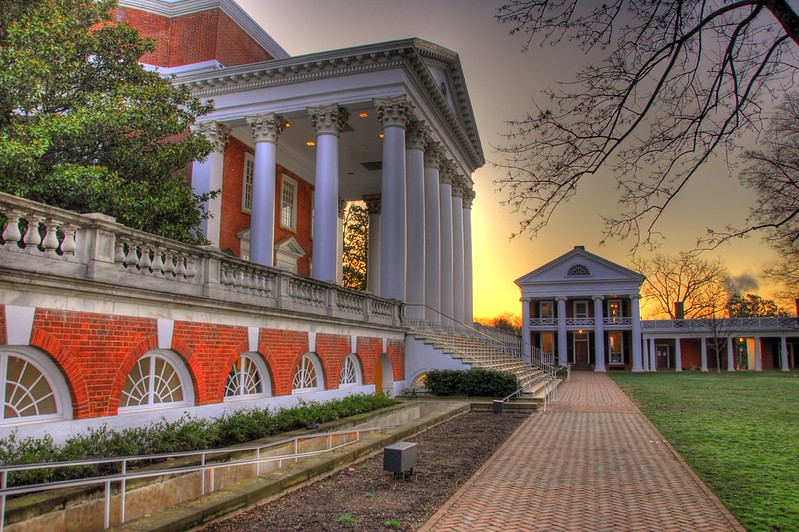
On June 25–27, 2027, the UVA Center for Digital Editing’s eLaboratories (eLabs) and the Association for Documentary Editing (ADE) will host a joint hybrid conference in Charlottesville, VA. Both organizations invite participation by documentary editors, recovery professionals, public historians, archivists, librarians, educators, students, digital humanists, community-based researchers, and all others involved in expanding access to documents from the past. We look forward to conversations about methodologies, technologies, formats, contents, audiences, and other facets of editing and recovery work. On June 24, eLabs will host in-person workshops on key topics in recovery and editing.
The conference theme will be “Editing at a Crossroads.” The fields of editing and recovery are always evolving, but their practitioners now face stark challenges and decisions. The emergence of artificial intelligence, changes in the funding landscape, the expansion of user audiences, experimentation with project structures, and the proliferation of publication options are among many developments forcing us to reevaluate, revise, or advocate for our work. The ADE and eLabs invite proposals for presentations on all facets of recovery and editing. We particularly welcome those that explore the changes affecting this work and describe or propose strategies for addressing them.
Proposal topics may include, but are not limited to:
Methodologies
- Perspectives on how the historiographical treatment of historical actors and subjects shapes editorial and recovery methodologies
- Perspectives on the definition, goals, and values of editing and recovery work
- Approaches to editorial practice, publication, and sustainability within cooperative publishing models
Funding of Editions
- Reflections on and responses to federal and state opportunities for funding; legislative, executive, and judicial decisions affecting funding and research; and other changes in government policies
- Methods for fostering or engaging institutional support for editing and recovery projects at colleges, universities, historical societies, and other hosting organizations
- Strategies for identifying and cultivating private funding sources, including foundations and individual donors
Audiences
- Changes in audiences, patterns of use, and expectations for documentary editing and recovery projects
- Changes in project conceptualization, workflows, outputs, selected tools, outreach, or platform design for reaching, engaging, and supporting new users
- Strategies for addressing web accessibility and updated ADA guidelines in digital publications, such as changes in methodology, design practices, and tools and technologies
- Models for democratizing participation in research, editing, and public knowledge-making
- Pedagogical applications of editing and recovery work, including classroom integration, public-facing interpretation, and training programs in recovery and editing themselves
Project Structures
- Methodological approaches to documentary editing and recovery across projects of different scale, duration, staffing structure, funding models, and institutional support
- Methods, challenges, and impacts of balancing project work with teaching, research, or administrative responsibilities
- Students’, volunteers’, and communities’ roles in recovery or editing projects, and approaches to fostering meaningful participation, shared ownership, and recognition of their contributions
- Collaborative models of editing across departments, institutions, disciplines, and communities
Publication and Outputs
- Impacts of digital publishing on the goals, methods, and meanings of editions, archives, and research collections and the role of print publications in a digital and AI-integrated world
- Opportunities arising from the treatment of editorial output as data (versus text)
- Environmentally sustainable practices in the methodology, design, or tools selected for digital publications
- Long-term preservation strategies for digital editions, archives, or research collections
Artificial Intelligence
- Uses of AI to support or enhance project outputs, to facilitate collaboration, and to improve accessibility or discoverability
- Ethical and practical considerations in deciding where to incorporate AI into workflows and how to retain human labor and judgment
- Impacts of readers’ and corporations’ deployment of AI, such as the use of chatbots for research and data sweeps of the internet, on editing and recovery projects
We welcome proposals for individual papers, full panels, roundtables, digital showcases, posters, and lightning talks. A panel consists of three related papers plus a moderator. A digital showcase is a 25–30 minute demonstration of a digital project, tool, or platform or of multimedia scholarship. A lightning talk is a 3–5 minute presentation summarizing complete or ongoing work. At this hybrid conference, all presentations except posters may be given either in person or remotely. You may propose an alternative presentation format; if you do so, please explain why none of those listed is appropriate. For more details on proposal requirements and to submit a proposal, visit the proposal form. You will be required to acknowledge that your presentation may be viewable on Zoom by virtual registrants. You will choose whether to grant or to withhold permission for your presentation to be recorded. Please submit your proposal no later than January 29, 2027.
eLabs also welcomes proposals for workshops to be held on June 24. Please submit a proposal for in-person workshops on important topics in recovery or editing, via the same form, no later than January 29, 2027.
Please contact Katie Blizzard (kal3aw@virginia.edu) or Michael Cohen (mdcohen@american.edu), Program Committee cochairs, with any questions.
Thanks to generous support provided by the National Endowment for the Humanities to the Center for Digital Editing, travel and lodging costs for all accepted presenters will be covered.
Proposal Form: https://forms.gle/TdSaKVf8Qhct6W728


