
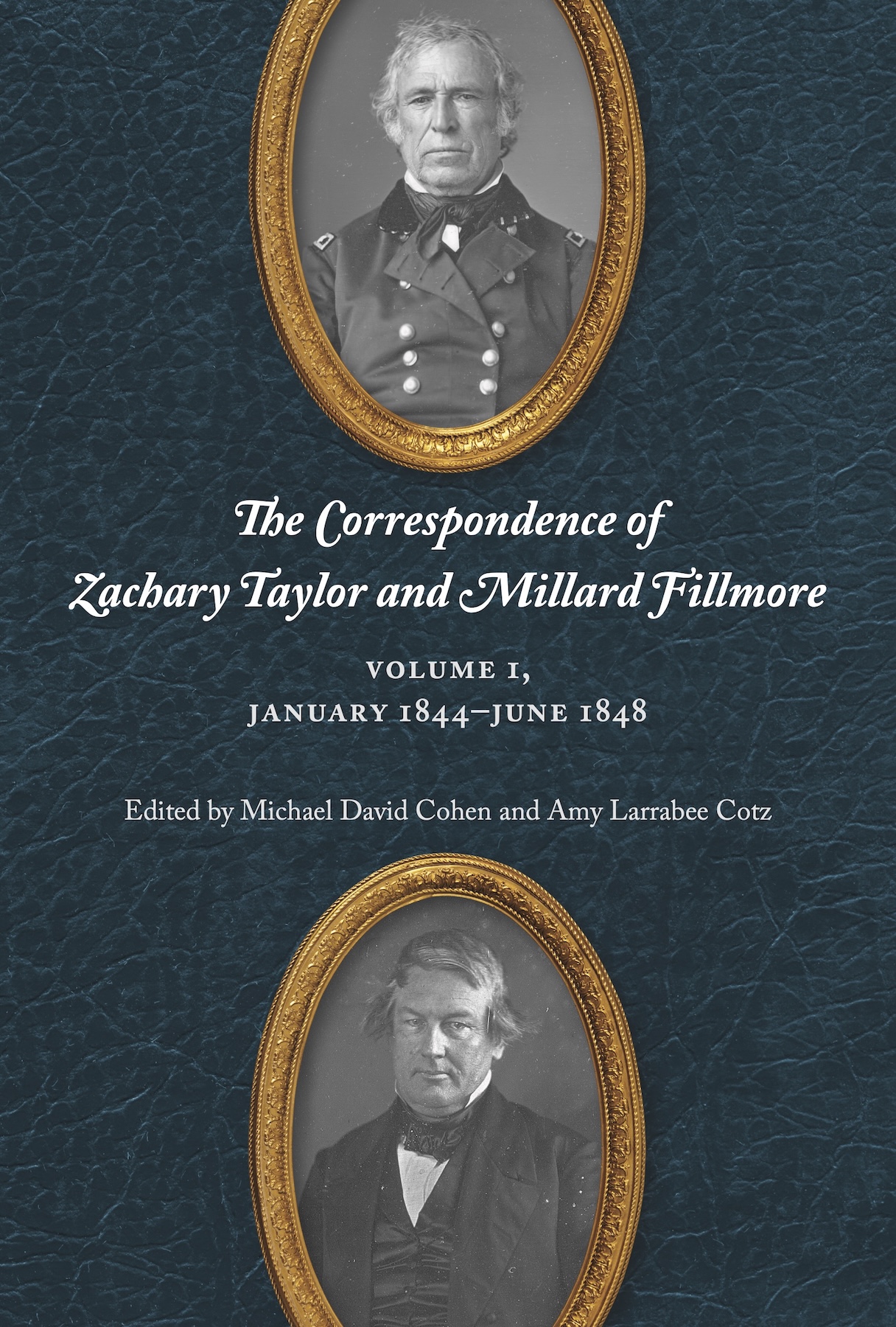
We are delighted to announce the publication of volume 1 of The Correspondence of Zachary Taylor and Millard Fillmore. The first in a three-volume series from the University of Tennessee Press, it was edited by Michael David Cohen and Amy Larrabee Cotz at American University’s Center for Congressional and Presidential Studies.
This series features letters written by or to Zachary Taylor and Millard Fillmore, the twelfth (1849–50) and thirteenth (1850–53) presidents of the United States. It begins in 1844, when they became prominent national figures. It will continue through Taylor’s death in the White House and end, in 1853, with Fillmore’s political retirement. The letters document diverse perspectives on a growing and divided nation.
In that decade, the United States expanded its boundaries while advancing toward civil war. Americans debated Caribbean and European revolutions, import tariff adjustments, a global cholera pandemic, the sale of alcohol, and Indigenous peoples’ expulsion from the East. Presidents Taylor and Fillmore worked with Congress on the Compromise of 1850, an attempt to bridge the widening rift over the status of western territories and the enslavement of Black Americans.
Volume 1 begins with the two men’s emergence as national leaders and ends with their nominations as president and vice president. In 1844–45, Taylor, a Baton Rouge–based cotton planter and army general, gathered troops near the US border with Texas. He soon led them into that republic, which the United States aimed to annex, then into Mexico, which still claimed Texas. In 1846–47, Taylor commanded forces in the Mexican-American War. That concluded in 1848 with the US acquisition of half of Mexico.
Fillmore, a Buffalo lawyer and former congressman, failed in his bids in 1844 for the vice presidency and the New York governorship. He nonetheless contributed to the debate about Texas annexation and slavery. He became the founding chancellor of the University of Buffalo in 1846 and was elected state comptroller in 1847. In the latter role, he enforced treaties with Native peoples and state laws affecting taxes, religion, and public schools.
In June 1848, the Whig Party paired these very different men on its presidential ticket. This volume comprises their incoming and outgoing letters about war, immigration, voting, art, literature, gender, agriculture, technology, medicine, and more. Many discuss the people forced to labor on Taylor’s Mississippi plantation and his skepticism of partisanship and presidential authority. The letters’ authors range from the powerful and famous to the vulnerable and obscure. Over all loom questions of slavery, expansion, and the survival of the Union.
Volume 1 was made possible by generous support from the National Historical Publications and Records Commission, the National Endowment for the Humanities, Summerlee Foundation, the Gladys Krieble Delmas Foundation, the Watson-Brown Foundation, Delaplaine Foundation Inc., and the William G. Pomeroy Foundation.
The volume is available from booksellers or directly from the University of Tennessee Press.


